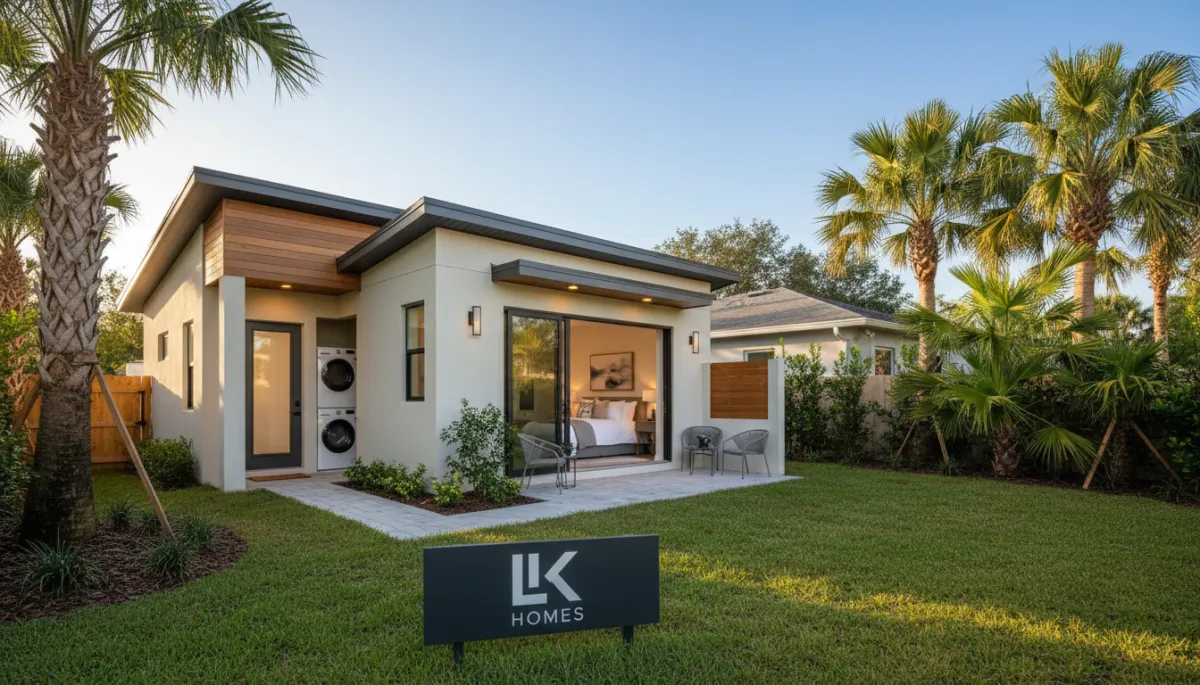
Maximize ADU Rental Income in Florida
Real Estate Investing, ADU Rental Income Florida, Accessory Dwelling Units
ADU as a Rental Unit in Florida: How Much Can You Actually Make?
If you own property in Florida, an accessory dwelling unit (ADU) may be the highest-yield asset you can build on land you already control. But the only question that really matters is: what does it actually put in your pocket after costs, not on a glossy brochure?
How ADU Rental Income Works in Florida: The Numbers First
In Florida, a well-designed accessory dwelling unit typically rents for $1,000–$2,500+ per month, depending on size, finishes, and—most importantly—location. Recent statewide ADU data for 2026 shows many units in major metros renting in the $1,500–$3,500 per month range, with markets like Miami, Tampa, Orlando, and Jacksonville each supporting strong ADU premiums over standard one-bedroom apartments.1
For LK Homes clients, we typically underwrite conservative long-term ADU income in the $1,200–$2,200 per month band for most urban and suburban locations. That’s $14,400–$26,400 in gross annual income from a structure sitting on land you already own. A $200,000 ADU generating $18,000 annually is a 9% gross yield before expenses—strong relative to many Florida investment properties in today’s market.
📌 Key Takeaway: In Florida’s 2026 market, a properly designed ADU can outperform a separate rental purchase on a yield basis, with lower entry risk because you’re building on your own lot.
Long-Term vs Short-Term ADU Rentals in Florida: Which Pays Better Now?
Florida gives you two main income strategies for an accessory dwelling unit rental: long-term leases (typically 12 months) and short-term rentals (nightly/weekly stays). Both can work. The right choice depends on your risk tolerance, local rules, and how hands-on you want to be.
Long-Term ADU Rentals: Stability and Lower Friction
Typical rent range: $1,000–$2,500+/month depending on size and metro (Miami, Tampa, Orlando, Jacksonville, etc.).
Pros: Predictable cash flow, fewer turnovers, less wear and tear, simpler compliance and tax reporting.
Cons: Slightly lower theoretical ceiling compared to high-performing short-term rentals in tourist zones.
With Florida adding roughly 467,000 new residents annually, demand for long-term rentals remains structurally strong—even as new multifamily supply softens rent growth in some metros.2 For most homeowners we work with, the long-term route wins on a risk-adjusted basis.
Short-Term ADU Rentals: Higher Gross, More Regulation and Work
Typical revenue profile: Potentially higher monthly gross than a long-term lease during peak season, but volatile and occupancy-dependent.
Regulatory reality: Florida’s DBPR treats rentals under 30 days, more than three times per year, as licensed public lodging. Local governments overlay their own rules—registration, minimum stays, occupancy caps, parking, and noise standards.Florida DBPR
Trend: Many Florida counties and cities are tightening short-term rental rules with stricter enforcement, higher fines, and more operational requirements.Florida DBPR – Short-Term Rentals
If you’re an experienced host and your zoning clearly allows it, an ADU can perform well on a nightly basis. But for most Florida homeowners, we see a clear shift toward long-term ADU rentals for stability, regulatory simplicity, and more “set it and forget it” income.
💡 Pro Tip: When we design an ADU at LK Homes, we assume a long-term rental baseline. If short-term is allowed, it becomes optional upside—not the only way to make the numbers work.
How to Set Rent for an ADU in Florida (Without Guessing)
Setting ADU rent in Florida is not about picking a number that “sounds good.” It’s about pricing at the intersection of market data, unit quality, and tenant profile. Here’s a straightforward framework we use with clients who plan to rent out their LK Homes ADUs:
Start with comps: Look at one-bedroom and studio rentals within a one- to three-mile radius on major platforms. Focus on actual leased rates when possible, not just asking prices. Remember that newer, private ADUs often command a premium over older apartment stock.
Adjust for ADU advantages: If your unit is new construction, has a separate entrance, in-unit laundry, and a private outdoor space, add 5–20% above average one-bedroom rents in your submarket. Tenants pay for privacy and convenience.
Test the market: List slightly above your target and watch response. If you’re not getting quality inquiries in 7–10 days, adjust down in $50–$100 increments until you hit the velocity you want.
Protect for vacancy: When you underwrite your ADU, assume at least one month of vacancy per year for long-term rentals. If you beat that, your actual returns are higher than your base case.
Statewide, typical asking rents hover around $1,900 per month for standard rentals, but ADUs with strong design and privacy often outperform that baseline in desirable neighborhoods.3 The design decisions you make at construction time directly determine whether you’re at the low or high end of the ADU rent range in your city.
What Expenses to Account For: From Gross Rent to Real Net Income
Investors care about net, not gross. A Florida ADU that collects $2,000 per month but eats $1,200 in hidden costs is not a win. Before you build, you should have a clear picture of the expense stack. Here’s what to model realistically:
Financing cost: Additional mortgage or HELOC payment if you’re borrowing to build the ADU. For a $200,000 build, your monthly debt service will depend on rate and term, but it’s often in the $1,100–$1,400/month range at current rates for many homeowners.
Property taxes: An ADU increases assessed value. The incremental tax hit varies by county, but we typically underwrite 0.8–1.2% of build cost per year as additional tax burden (i.e., $1,600–$2,400 annually on a $200,000 ADU).
Insurance: Higher replacement value means higher premiums. Expect a modest bump—often a few hundred to a couple thousand dollars per year depending on coverage and coastal exposure.
Utilities: You can either sub-meter and bill tenants or bake an estimated amount into rent. For a 500–800 sq ft ADU, power and water usage are meaningful but manageable. Many LK Homes clients structure rent to include a utility allowance and keep accounts in their name for control.
Maintenance and reserves: Even new construction needs a budget. We recommend setting aside 5–10% of gross rent annually for repairs, capital reserves, and occasional upgrades to keep the unit competitive.
Management and leasing costs: If you self-manage, your cash cost is low but your time cost is real. If you hire a property manager, expect 8–10% of collected rent plus a leasing fee for new tenants.
📌 Key Takeaway: A realistic expense load for a long-term ADU rental in Florida often lands around 20–35% of gross rent, excluding financing. With thoughtful design and tenant selection, you can stay near the lower end of that range.
Calculating Actual Net Return: A Realistic Florida ADU Scenario
Let’s put this together with numbers a Florida investor can respect. Assume:
ADU build cost: $200,000
Long-term rent: $1,500/month ($18,000/year)
Vacancy: 1 month per year (11 months paid) → $16,500 collected
Operating expenses (taxes, insurance, maintenance, utilities, management) at a conservative 25% of collected rent:
Operating expenses: 0.25 × $16,500 = $4,125/year
Net operating income (NOI): $16,500 – $4,125 = $12,375/year
On a $200,000 build, that’s a 6.2% unlevered yield—without counting tax benefits or the equity bump. If you push rent closer to $1,800/month (common in strong Florida metros), you’re at $19,800 collected, ~<$15,000 NOI, and a 7.5%+ unlevered yield. For context, many Florida investment properties today trade at cap rates meaningfully lower than that, especially in desirable neighborhoods.
On top of income, properties with ADUs sell 42% faster and command 23–28% value premiums compared to similar homes without an ADU. That’s additional equity on top of annual cash flow, which compresses your true payback period even further.
Why Design Decisions Determine Your Rent: A Builder’s First-Hand Take
Speaking as a Florida ADU builder, I see the same pattern over and over: two units, same square footage, same city, wildly different rents and tenant profiles. The difference isn’t luck—it’s design. Most ADU builders think in terms of square feet. At LK Homes, we think in terms of dollars per month and tenant quality.
When we design an ADU, every decision is filtered through one question: “Will this help you command higher rent from better tenants with less friction?” That affects:
The placement of the entrance relative to the main home and street.
How sound travels between structures and within the ADU itself.
Whether the tenant has a defined outdoor area that feels like “theirs.”
The finish package—not luxury for its own sake, but the level that attracts stable, higher-income tenants without overcapitalizing.
Most ADU builders are trying to hit a low construction cost. We’re focused on lifetime yield. A slightly higher build cost that supports $200–$400 more in monthly rent is often a far better investment than a bare-minimum structure that struggles to attract quality tenants. That’s the gap between a unit that’s always leased to strong applicants and one that sits on the market or attracts problems.
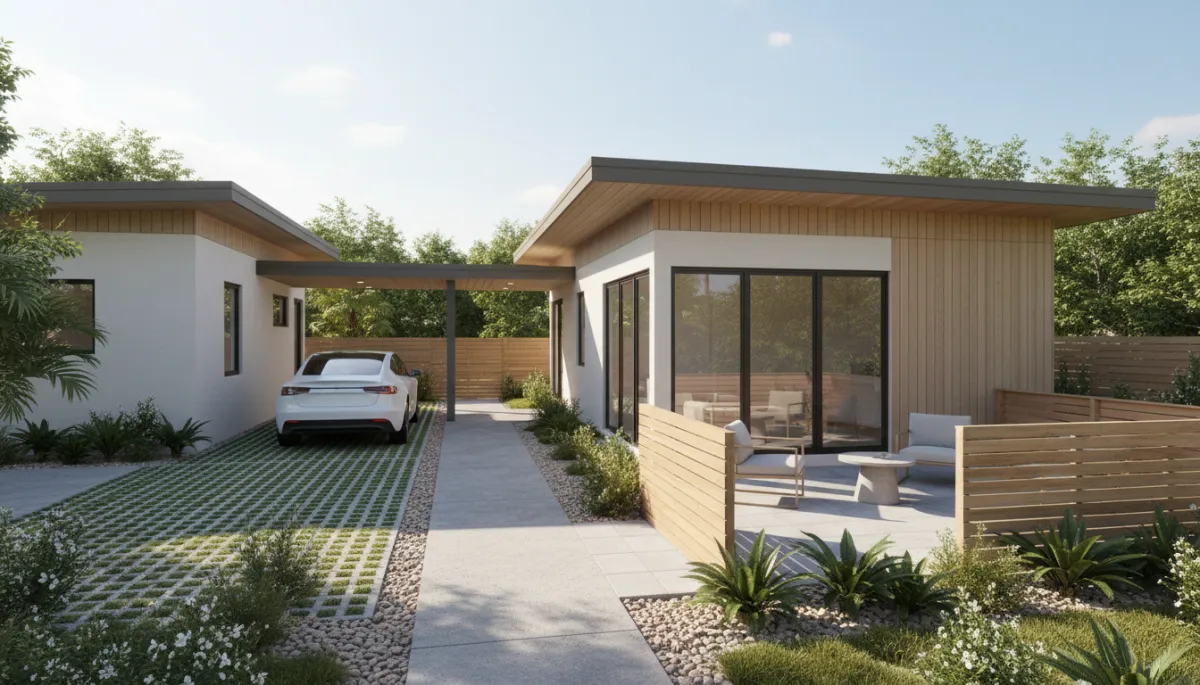
Thoughtful design details consistently translate into higher rents and better tenant demand.
Seven Features That Increase ADU Rental Income in Florida
Based on real projects across Florida, these are the seven highest-impact features we see for boosting ADU rental income and tenant quality. The first three move the needle the most.
Separate entrance (top impact): Tenants want to feel like they’re renting a home, not a “room behind someone’s house.” A clearly defined, private entry path with lighting, address numbers, and its own door changes the perceived value instantly and supports higher rent.
Private outdoor space: Even a small fenced patio, side yard, or balcony materially improves livability. In Florida’s climate, usable outdoor space is a premium amenity. We routinely see tenants choose a slightly smaller ADU with a private outdoor area over a larger unit without one—and pay more for it.
In-unit laundry: This is non-negotiable for many higher-income renters. Stackable washer/dryer units pay for themselves in rent and tenant satisfaction. It’s one of the strongest levers for reducing vacancy and increasing monthly income in Florida ADUs.
Quality finishes: You don’t need marble, but you do need durable, modern finishes: LVP or tile, solid cabinetry, and clean, neutral color palettes. Tenants look for “new and well-kept,” and they’re willing to pay for it—especially in a state where renters already spend a high share of income on housing.4
Parking: Dedicated or clearly designated parking is a major value driver in many Florida neighborhoods. If tenants have to fight for street parking, your rent ceiling drops and your pool of applicants shrinks.
Soundproofing: Good fences make good neighbors; good insulation makes good landlord–tenant relationships. We prioritize wall assemblies, door quality, and layout to reduce sound transfer. Quiet units attract long-term, higher-quality tenants who stay and renew.
Curb appeal from the street: The ADU doesn’t have to dominate the main house, but it should feel intentional. A cohesive look and maintained landscaping signal to prospective tenants—and future buyers—that this is a professionally executed income asset, not an afterthought.
💡 Pro Tip: Separate entrance, private outdoor space, and in-unit laundry are the three highest-impact features for maximizing ADU rent in Florida. LK Homes designs them in from day one, not as costly add-ons later.
Florida Market Tailwinds: Why ADU Demand Isn’t a Fad
Florida’s rental market has cooled from the pandemic spike, but the underlying drivers that support ADU income are still firmly in place:
The state continues to add around 467,000 new residents per year, keeping long-term rental demand elevated even as multifamily vacancies tick up.2
Typical market rents sit near $1,900/month statewide, with many metros higher—especially for newer, well-located units.3
ADUs often rent at a premium to standard one-bedroom apartments because they offer privacy, outdoor space, and “small home” living rather than a hallway and elevator experience.
At the same time, tightening short-term rental regulations in many counties are pushing investors toward legal, long-term-friendly configurations—and a compliant ADU on your primary residence fits that demand perfectly. You’re not competing with big institutional landlords; you’re serving local renters who want a stable, private place to live.
Success Story: A Florida Homeowner’s 12-Month ADU Rental Performance with LK Homes
Consider a recent LK Homes client in Central Florida—we’ll call him Mark, a 52-year-old engineer who wanted a reliable income stream without buying another stand-alone rental. He had a deep backyard, strong zoning, and a clear objective: maximize long-term rental income while keeping his own privacy intact.
Build: 650 sq ft detached one-bedroom ADU with full kitchen, in-unit laundry, private side yard, and a dedicated parking pad. Total project cost (design, permitting, construction): $210,000.
Design priorities: Separate entrance from a side street, sound-buffered wall facing the main house, and a small fenced patio with its own gate. Finishes were clean and durable—LVP flooring, quartz counters, stainless appliances, and neutral paint.
We underwrote the unit at $1,650/month long-term rent. The market responded stronger than expected. Mark listed at $1,750 and had multiple qualified applicants within a week. He signed a 12-month lease at $1,725/month.
Year 1 gross rent: $1,725 × 12 = $20,700
Vacancy: Zero between move-in and renewal (tenant extended)
Operating expenses: ~24% of gross (taxes, insurance, utilities, minor maintenance, self-managed)
First-year NOI landed around $15,700, putting his unlevered yield at roughly 7.5% on the $210,000 build. His appraised property value increased by approximately $160,000—not the full build cost, but a significant equity bump that improves his overall return profile and exit options.
Mark’s feedback was simple: “The ADU rents itself. The separate entrance and the patio make it feel like a standalone cottage. I don’t see the tenant, they don’t see me, and the check hits every month.”
ADU as a Near-Passive Income Asset: Why It’s Different from Buying Another Rental
For Florida homeowners, a rental ADU is arguably the closest thing to a passive income asset you can build on land you already own. Compared to purchasing a separate investment property, an ADU offers:
Lower entry risk: You’re not competing in a hot purchase market or overpaying for existing stock. You control the build, the quality, and the timeline. You also avoid some of the transaction costs tied to buying another property.
Operational simplicity: One tax bill, one insurance policy, one yard. You’re adding an income stream to an asset you already manage, not doubling your admin load.
Better risk-adjusted yield: With ADU rents in the $1,000–$2,500+ range and build costs that can often be recouped in 7–12 years through rent alone, your return profile is competitive with, and often superior to, many standalone rentals.1
Is an ADU “100% passive”? No. You still choose tenants, maintain the property, and make decisions. But when designed correctly and leased long-term, it’s about as close to passive as real estate income gets—especially when compared to managing multiple scattered single-family rentals around the state.
Why LK Homes for a Rental-Focused ADU in Florida
LK Homes—“Building Dreams Within Reach”—is a Florida new construction specialist that treats an ADU as an income-producing asset first, structure second. From day one, we design with:
Layouts that maximize livable space and privacy for both you and your tenant.
Separate entrances and circulation paths that support higher rent and better tenant relationships.
Finish levels intentionally chosen to attract quality tenants and minimize maintenance—not the cheapest materials that cost you in vacancy later.
Clear conversations about your income goals, financing plan, and exit strategy, so the ADU supports your broader portfolio—not just your backyard aesthetics.
Most builders will happily construct a small structure on your lot. LK Homes will help you build a Florida accessory dwelling unit rental that’s engineered for performance in a market where demand is strong, regulations are shifting, and design directly impacts your bottom line.
FAQ: ADU Rental Income in Florida
1. How much can I realistically make renting an ADU in Florida?
Most Florida ADUs we see perform in the $1,000–$2,500 per month range for long-term rentals, with many urban and coastal units achieving even more. A conservative underwriting baseline is $1,200–$1,800/month for a well-designed one-bedroom ADU in a solid neighborhood. That’s $14,400–$21,600 in annual gross income, before expenses. Short-term rentals can sometimes exceed that on a monthly basis but come with more volatility and regulatory overhead.
2. Is a long-term or short-term rental strategy better for an ADU?
For most Florida homeowners, long-term rentals are the better risk-adjusted play. You get stable income, fewer turnovers, and simpler compliance. Short-term rentals can work if zoning clearly allows them and you’re prepared to manage licensing, taxes, and guest turnover. But with many counties tightening short-term rental rules, we design LK Homes ADUs to function as strong long-term rentals first, with short-term potential as optional upside where appropriate.
3. What kind of return on investment can I expect from an ADU?
A $200,000 ADU generating $18,000 annually is a 9% gross yield. After realistic expenses, many owners see 6–8% unlevered yields, plus a significant increase in property value—often in the 20–30% of build-cost range. Properties with ADUs also tend to sell faster and at meaningful premiums. When you factor in both cash flow and equity, a well-executed ADU can outperform many standalone rentals on a total-return basis.
4. What are the biggest mistakes that reduce ADU rental income?
The most common income killers are poor design decisions: shared or awkward entrances, no private outdoor space, no in-unit laundry, thin walls, and finishes that feel cheap or dated on day one. These choices push you to the low end of the rent range and attract less stable tenants. Cutting corners on design to save a few thousand upfront often costs you tens of thousands over the life of the asset in lost rent and higher vacancy.
5. How do I get started with an income-focused ADU in Florida?
Start by clarifying your income target, budget, and timeline. Then talk to a builder who understands ADU investment return in Florida, not just construction. At LK Homes, we review your lot, zoning, and financial goals, then design an ADU around rental performance—from layout and privacy to finish level and parking. From there, we handle permitting and construction so you can focus on financing and lease-up.
Turn Your Backyard into a Florida Income Asset with LK Homes
If you’re serious about using an accessory dwelling unit as a rental in Florida, you need more than square footage—you need a plan for ADU rental income Florida that holds up under real numbers, real regulations, and real tenant expectations. LK Homes designs and builds ADUs with rental performance in mind from day one, so your backyard project behaves like the income asset it is meant to be.
Ready to see what an ADU could earn on your property, in your city, with your budget? Schedule a free consultation with LK Homes today to walk through scenarios, costs, and projected returns specific to your lot. Your land is already working for you as a home. It can also start working for you as an income stream.
