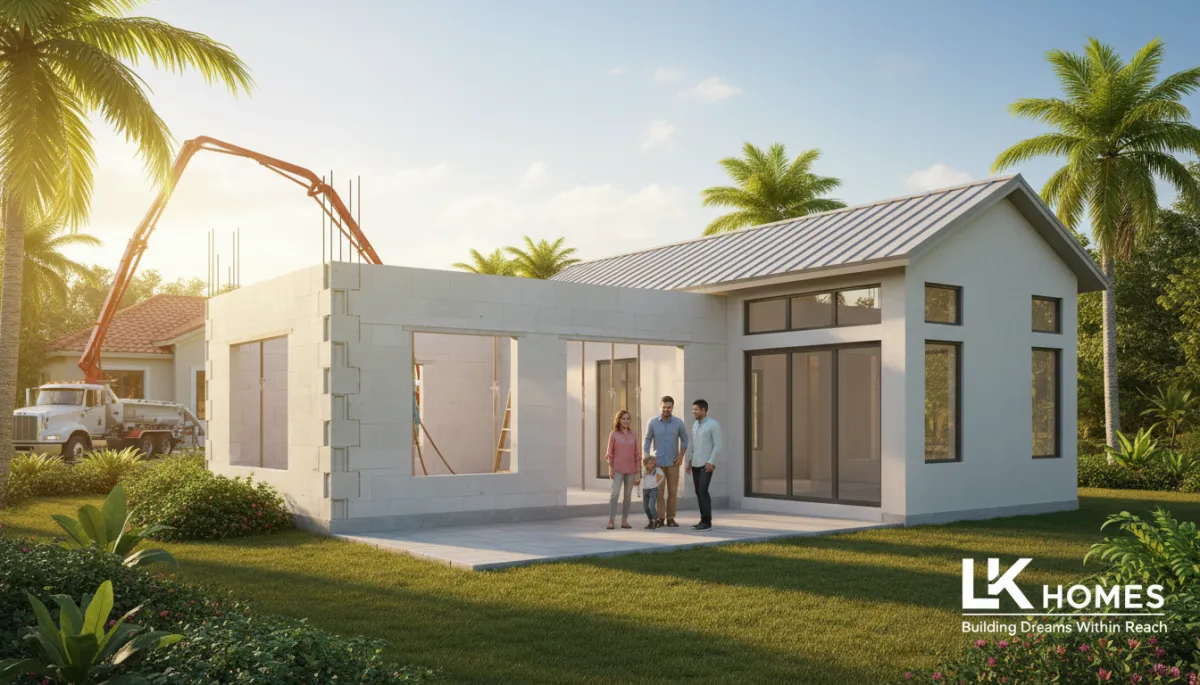
Build Smart: ADU with ICF in Florida
ICF Construction, ADU Construction Florida, Rental Unit New Construction Florida
Building an ADU in Florida With ICF: The Smartest Investment on Your Property
LK Homes explains why insulated concrete forms (ICF) are the smartest way to build a Florida accessory dwelling unit—whether you want a guest house, in-law suite, or income-producing rental that pays you back for decades.
What Is an ADU—and Why Florida Homeowners Are Paying Attention
An accessory dwelling unit (ADU) is a self-contained living space on the same lot as your primary home. Think of it as a second small home on your property, with its own entrance, kitchen, bathroom, and sleeping area. In Florida, ADUs are increasingly being used as:
Detached guest houses behind or beside the main home
Attached in-law suites with a shared wall and separate entrance
Over-garage apartments using vertical space you already own
Converted portions of the main home with a dedicated entry and kitchenette
For Florida owners, an ADU solves two problems at once: family needs and financial security. It can house parents, adult children, or long-term guests while also functioning as a high-demand rental in a state with strong population and tourism growth. According to Florida Realtors, ADUs are a rising tool to address housing affordability and supply statewide (floridarealtors.org).
How Florida Law Is Making ADUs Easier to Build
Until recently, many Florida cities treated ADUs as a niche exception. That’s changing. Florida House Bill 1339, passed in 2020, pushed local governments to treat ADUs as a key part of the state’s affordable housing strategy. The legislation authorizes local governments to allow accessory dwelling units in areas zoned for single-family residential use and encourages them to streamline approvals for these small homes (flsenate.gov).
By 2026, many jurisdictions are updating their comprehensive plans and zoning codes to better support ADUs. Practically, this means:
More neighborhoods where ADUs are explicitly allowed on single-family lots
Clearer rules around size, height, and placement on your property
In some areas, faster permitting for ADUs tied to long-term housing, not short-term vacation rentals
📌 Key Takeaway: Florida’s policy direction is clear: ADUs are part of the long-term housing solution. Building one now positions you ahead of the curve as demand increases.
Why ICF Is a Game-Changer for Every Type of ADU
Insulated concrete forms (ICF) are hollow foam blocks that stack like Lego, then are filled with reinforced concrete. The result is a highly insulated, hurricane-strong wall system. For ADUs, where every square foot has to perform, ICF is especially powerful.
Detached ICF Guest House or Rental Cottage
A detached ADU gives maximum privacy and flexibility. Built with ICF, it becomes:
Quiet and private thanks to thick, sound-dampening walls—ideal when renters or in-laws are just steps away from your main home
Storm-ready in a state where wind and flying debris are facts of life
Energy efficient enough that monthly utility costs are often a selling point in your rental listing
Attached In-Law Suite With ICF
When you attach an ADU to your main home, sound, comfort, and safety become even more important. ICF excels here too:
Family members are close by—but acoustic separation keeps both sides comfortable and rested
Consistent temperatures help older parents or young children stay safe in Florida’s heat and humidity
Over-Garage or Compact ICF Studio
Smaller footprint ADUs—like studios or one-bed units—are where ICF really shines. Because the surface area per square foot of living space is high, efficiency per square foot matters most. ICF’s continuous insulation reduces wasted energy and makes a small space feel solid, quiet, and comfortable instead of flimsy or “apartment-like.”
💡 Pro Tip: Whether detached, attached, or above a garage, an ICF ADU qualifies for the same energy efficiency and insurance benefits as a full ICF home—something most wood-framed ADUs can’t match.
The ROI: What an ICF ADU Can Earn You in Florida
From an investment standpoint, an ADU is one of the most efficient ways to turn unused land into monthly income. Across many Florida markets, a well-designed, code-compliant ADU can realistically generate $1,000–$2,500 per month in rental income, depending on location, size, and finishes. That’s $12,000–$30,000+ per year from space that previously earned you nothing.
Because ICF ADUs are more energy efficient and resilient, they often attract higher-quality tenants who value quiet, comfort, and storm security. Lower operating costs and fewer repair calls protect your cash flow over the long term. When you combine rental income with potential insurance savings and energy savings, the payback period can be surprisingly short—especially in high-demand coastal or university-adjacent areas.
Real-World Story: Housing Mom and Earning $1,600/Month
Consider a recent LK Homes client in Central Florida, a couple in their early 50s with a paid-off primary home on a generous lot. Their goals were clear: bring an aging mother closer for daily support and create a new income stream to boost retirement savings.
We designed and built a 650-square-foot detached ICF ADU with a one-bedroom layout, full kitchen, accessible bathroom, and covered porch. For the first two years, Mom lived there full-time. The ICF construction kept the interior cool and quiet, even during summer storms, and her electric bills stayed comfortably low—critical on a fixed income.
When Mom later moved into assisted living, the family converted the ADU into a long-term rental. Within a week of listing, they secured a tenant at $1,600 per month. Because the unit was built with durable ICF walls, low-maintenance finishes, and energy-efficient systems, their ongoing costs are modest. The ADU now:
Offsets a large portion of their property taxes and insurance each year
Provides a backup living option for adult children if they ever need to move home temporarily
One ICF ADU can support parents today and generate consistent rental income tomorrow.
Multigenerational Living: The Trend Your Property Can Capitalize On
Multigenerational living—multiple adult generations under one roof or on one property—is no longer unusual. Nationally, the share of people living in multigenerational households has more than doubled since 1971, rising to about 18% of the population (pewresearch.org). Florida’s affordability pressures and aging population are pushing this trend even faster. In 2024, 17% of homebuyers purchased multigenerational properties, the highest share on record (floridarealtors.org).
An ICF ADU gives your family options that align with this shift:
Aging parents live nearby with independence and dignity, not in a spare bedroom down the hall
Adult children can launch careers without being locked out of Florida’s rising rental market
Family caregivers cut commute times and stress, with everyone on the same property
📌 Key Takeaway: Multigenerational living is the fastest-growing housing trend in the U.S. An ICF ADU positions your property to serve this demand—whether for your own family or future buyers.
Builder’s Perspective: Why Wood-Framed ADUs Are a Missed Opportunity
Speaking as a builder who has worked with both wood framing and ICF in Florida, I see a wood-framed ADU as a short-term decision in a long-term space.
On paper, wood can look slightly cheaper up front. But when we run the numbers with clients—factoring in higher energy bills, more maintenance, potential storm repairs, and less favorable insurance treatment—the “savings” often disappear within the first several years. Meanwhile, the structure that’s supposed to be your most flexible asset is more vulnerable to wind, water, pests, and noise.
An ADU is not a shed. It’s a mini home that sits at the center of your family and financial plans. From my perspective, building it out of wood is like buying the cheapest possible car for a cross-country road trip—you might reach your destination, but you’ll pay for it in comfort, reliability, and stress. ICF, on the other hand, gives you a structure that feels solid from day one and continues to pay you back in performance every year you own it.
If you’re comparing ICF vs. wood frame for your ADU, it’s worth looking at the whole picture—initial cost, operating cost, and long-term value. (We break this down in detail in our ICF vs. wood frame comparison and our ICF cost overview.)
Before You Break Ground: Zoning, Permits, Utilities, and Size
A smart ADU project starts long before concrete is poured. Here’s what Florida homeowners should understand up front—and how LK Homes simplifies the process by handling design, permitting, and construction under one roof.
Zoning and Setbacks
Even with HB 1339, each city and county applies ADU rules slightly differently. Key questions we help you answer include:
Is your lot zoned to allow an ADU, and if so, how many square feet are permitted?
What are the side, rear, and front yard setbacks for an accessory structure?
Are there height limits or design requirements (roof pitch, exterior materials, parking)?
Permitting and Plans
ADUs must meet the same Florida Building Code standards as any other residence. That means structural engineering, energy calculations, and life-safety requirements all apply. LK Homes prepares the full plan set, coordinates with engineers familiar with ICF systems, and submits everything to your local building department. We keep you informed, but we own the process so you’re not chasing paperwork or clarifications on your own.
Utility Connections and Site Logistics
How your ADU ties into existing utilities can impact both cost and schedule. Options include:
Shared or separate electric meters, depending on how you plan to bill tenants or track expenses
Extending water and sewer lines from the main home or connecting at the street, subject to local requirements
Evaluating your existing septic capacity if you’re not on municipal sewer
We walk the site with you, map utility routes, and design the ADU location to balance cost, privacy, and access for future tenants or family members.
Getting the Size and Layout Right
Bigger isn’t always better. Because ICF performs so well thermally and acoustically, a well-designed 500–800 square foot ADU can live like a full-sized home. We focus on:
Smart storage and flexible rooms that can serve as an office, bedroom, or den over time
Aging-in-place features like zero-threshold entries, wider doors, and curbless showers—small investments that protect your family’s options later
💡 Pro Tip: Start with your end uses in mind—Will this be a rental, a parent’s home, a future office?—then size the ADU to support those goals without overspending on square footage you don’t need.
The ICF ADU as a Legacy Asset
When you step back, an ICF ADU isn’t just a project—it’s a legacy asset that can serve three roles over its life:
Income engine today: With $1,000–$2,500 per month in potential rent, your ADU can strengthen your monthly cash flow and help you weather economic ups and downs in Florida’s dynamic market.
Family safety net tomorrow: As family needs change—parents age, adult children move back, or you want a caregiver close by—the ADU flexes with you, providing dignified, private housing steps from your door.
Property value always: In a state where multigenerational living and flexible housing are on the rise, a well-built ICF ADU is a powerful differentiator when it’s time to sell. Buyers see not just extra space, but a ready-made income stream and housing solution.
Because ICF construction is durable and low-maintenance, your ADU is built to last across generations. You’re not just adding a building—you’re creating an asset that can help pay for college, supplement retirement, support aging parents, and ultimately make your property more attractive and resilient in a changing housing landscape.
Why Florida Homeowners Choose LK Homes for ICF ADUs
LK Homes is a Florida new-construction specialist focused on ICF homes and ICF ADUs. Under our “Building Dreams Within Reach” philosophy, we bring together:
Design, permitting, and construction under one roof so you’re not coordinating multiple firms or guessing at next steps
Deep experience with Florida-specific codes, ICF systems, and local zoning for ADU construction across the state
A practical, ROI-focused approach that respects both your financial goals and your family’s comfort
Whether you’re envisioning a compact rental studio, a comfortable in-law suite, or a flexible guest house that can evolve with your life, our team guides you from first idea to final walk-through. We’ll also help you understand how your ADU fits into your broader financial plan, from rental strategy to long-term resale value.
FAQ: Building an ICF ADU in Florida
1. How much does it cost to build an ICF ADU in Florida?
Costs depend on size, finishes, site conditions, and local requirements, but many ICF ADUs fall in a similar per-square-foot range as quality wood-frame construction. The difference shows up in lifetime cost: ICF’s energy efficiency, durability, and insurance advantages often make overall ownership cheaper. For a detailed breakdown, see our ICF construction cost guide, and we can provide a project-specific estimate during your consultation.
2. Can I use an ICF ADU for both family and rental over time?
Yes—and that’s one of the biggest advantages. Many of our clients start with an in-law living in the ADU, then transition to long-term rental later, or vice versa. We design layouts that work well in both scenarios, with private entries, full kitchens, and smart sound separation so you can adapt the space as your needs change.
3. Will my city or county actually allow an ADU on my lot?
In many Florida jurisdictions, the answer is increasingly yes, especially since HB 1339 encouraged local governments to permit ADUs in single-family zones. But the details—size limits, parking, design rules—vary. During our initial review, LK Homes checks your zoning, lot size, and local ordinances to confirm what’s possible before you invest in full design work.
4. How long does ADU construction typically take?
Timelines vary by jurisdiction and project scope, but a typical ICF ADU might take a few months for design and permitting, followed by several months of construction. ICF can streamline certain phases because walls go up quickly once the foundation is ready. We’ll give you a realistic schedule for your specific site and keep you updated at each milestone.
5. Is an ICF ADU worth it if I’m not sure I’ll rent it out right away?
Absolutely. Even if you use the ADU first as a guest suite, office, or family space, you’re still adding a high-value, flexible structure to your property. When you’re ready, you can pivot to renting and tap into that $1,000–$2,500 per month income potential. In the meantime, you benefit from extra space, improved property appeal, and a stronger long-term resale position.
Ready to Explore an ICF ADU on Your Florida Property?
If you own a home or land in Florida, an ICF accessory dwelling unit may be the smartest investment you can make on your property—one that supports your family, strengthens your finances, and adds lasting value in a changing housing market. LK Homes is here to help you evaluate what’s possible on your lot and design an ADU that fits your goals and budget.
Schedule a free consultation with LK Homes to discuss ADU construction in Florida, compare ICF to wood frame for your specific project, and start turning unused space into a legacy asset for your family.
