Build Your Custom Home in Florida: A Complete Guide
Custom Homes, Building on Your Land, Florida
Building on Your Own Land in Florida: Everything You Need to Know
If you already own land in Florida, you’re in one of the strongest positions a future homeowner can be in. You control the dirt. Now it’s about turning that land into a custom home that fits your life, your budget, and your long‑term goals—without getting lost in permits, red tape, and “who does what?” confusion. This guide walks you through the full process and shows how LK Homes helps landowners move from uncertainty to breaking ground with confidence.
Why Building on Your Own Land in Florida Is So Powerful
From a builder’s perspective, owning your land is the most financially powerful position you can be in as a Florida homeowner. When you buy in a typical subdivision, you pay a lot premium—often 20–30% of the total home price—for the privilege of having a builder-controlled homesite. That premium covers developer markup, marketing, and the convenience of “ready-to-build” lots, not necessarily better land or a better house.
When you already own the property, that lot premium disappears. Every dollar you invest goes into your actual home and site improvements, not a developer’s margin. You also gain:
Control over what gets built – Floor plan, orientation, outdoor spaces, and finishes are centered around your land and your lifestyle, not a cookie‑cutter subdivision plan book.
Control over how it’s built – Elevation, foundation type, wind resistance, and drainage can be tailored to your specific site conditions and local requirements.
Long-term equity upside – You’re pairing an appreciating land asset you already own with a new home, without paying for a developer’s infrastructure and marketing machine.
Across Florida, more owners are recognizing this advantage. Remote work flexibility, rising urban home prices, and a desire for privacy and space are pushing people toward rural and semi‑rural land. Central Florida and surrounding counties are seeing strong growth in “build on my land” projects as buyers look beyond crowded subdivisions and HOA‑heavy communities.
The Big Picture: How Building on Your Own Land in Florida Works
If you feel like you’re “supposed to know” where to start but don’t—that’s normal. Building on private land in Florida involves more moving parts than buying in a platted community, but with the right builder, it becomes a clear, step‑by‑step process. At LK Homes, we specialize in owner-provided land builds, handling everything from the first site walk to move‑in so you never have to coordinate a dozen vendors or argue with the county by yourself.
📌 Key Takeaway: Your land is the asset. The right builder is the guide who turns that asset into a home while protecting your time, budget, and sanity.
Step 1: Site Evaluation – Is Your Land Buildable the Way You Want?
Before you spend money on plans or permits, you need a professional site evaluation. This is where a builder like LK Homes walks your property and looks at access, topography, drainage, trees, and potential homesite locations. We also flag early red‑flags that could affect cost or feasibility, such as low areas, existing structures, or difficult drive access points.
LK Homes evaluates every owner-provided land site before recommending a build plan. This early step helps you avoid designing a dream home that doesn’t fit your lot, your budget, or your county’s rules. It’s also where we start aligning your wish list with what the land will comfortably support—house size, garage placement, outdoor living, and future additions like a shop or pool.
Step 2: Survey – Drawing the Lines Before You Draw the House
A current boundary survey is non‑negotiable. Even if you received one when you bought the property, your builder and county may require an updated version that shows:
Exact property lines and corners
Existing structures, driveways, fences, and improvements
Easements and rights of way (more on these later)
Your survey becomes the base map for your site plan. Without it, you risk placing the home too close to a property line, over a utility easement, or in an area that violates setbacks—mistakes that can delay permits or force costly redesigns. LK Homes coordinates the survey and integrates it directly into your site and foundation planning so everything lines up from day one.
Step 3: Zoning Verification – Confirming What You Can Actually Build
In Florida, zoning classification determines what can be built on your property—single‑family home, manufactured home, agricultural structures, accessory dwelling unit (ADU), and more. Zoning also dictates minimum lot size, maximum building height, and how many structures you can have. This must be confirmed with the county before any plans are drawn.
As your builder, LK Homes works with your county or municipality to verify zoning and identify any special overlays (like environmentally sensitive areas) that might change what’s allowed. Catching a zoning conflict early can save months of frustration and redesign. For many Central Florida landowners, this is the first moment they truly understand what their land can do for them—and it’s often more flexible than they thought.
Step 4: Flood Zone Status – Foundations and Insurance Depend on It
Florida is water‑rich—and that means flood zones are a reality. Flood zone status directly impacts foundation requirements and insurance costs and should be verified before design begins. Using tools like the FEMA Flood Map Service Center, we determine whether your property sits in a special flood hazard area and what base flood elevation (BFE) applies.
If your land is in a higher‑risk zone, your home may need to be elevated or designed with specific flood‑resistant measures. That affects foundation type, finished floor height, and sometimes even garage and storage layout. Knowing this upfront lets us design a home that stays compliant, insurable, and resilient—without surprise costs halfway through the process.
Step 5: Soil Testing – The Invisible Factor That Drives Your Foundation Cost
What’s under your feet matters as much as what you can see. Soil testing determines foundation type and is a non‑negotiable step before breaking ground. In Florida, sandy soils, clay pockets, organic material, and high water tables can all affect how we design your foundation and slab.
A geotechnical engineer will take samples from your property and provide a report that tells us:
Bearing capacity (how much weight the soil can support)
Drainage characteristics and potential for settlement
Whether special foundation designs, over‑excavation, or fill are required
LK Homes coordinates soil testing as part of our pre‑construction package for owner‑land builds. We use the results to engineer a foundation that is safe, code‑compliant, and cost‑efficient—so you’re not over‑building “just in case” or under‑building and risking problems later.
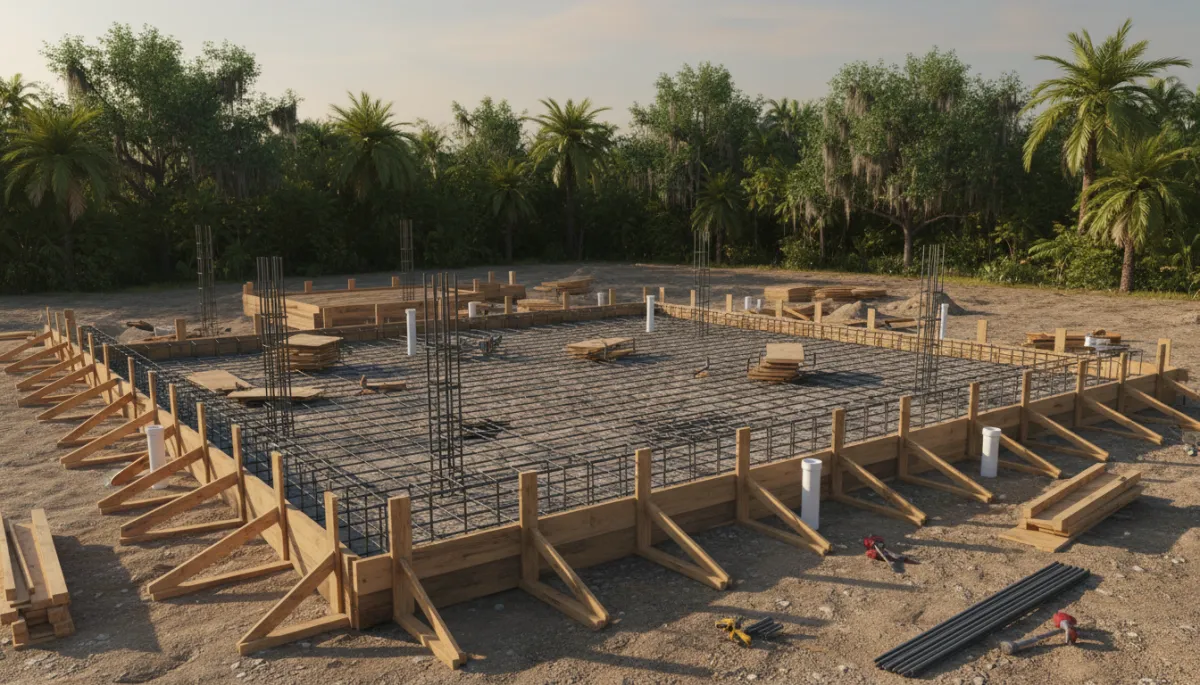
Proper soil testing and engineering upfront prevent costly foundation changes mid‑build.
Step 6: Utility Access – Septic vs. Sewer, Well vs. Municipal Water, and Power
Utility planning is where rural and semi‑rural builds differ most from subdivision homes. You’ll need a clear plan for:
Septic vs. Sewer – Many Florida land parcels, especially outside city limits, require an on‑site septic system. Installation typically ranges from $5,000–$15,000 for standard systems, though advanced systems can cost more in sensitive areas. Regulations are overseen by the Florida Department of Health; you can review state guidelines directly on their site for onsite sewage systems.
Well vs. Municipal Water – If public water isn’t available, you’ll need a private well. In Florida, well installation typically runs $5,000–$12,000 depending on depth and location. The Florida Division of Water Resource Management provides guidance and permitting information for wells and groundwater use; learn more on their Water Resource Management page.
Electric and Internet – We confirm which utility provider serves your area, where the nearest connection is, and whether any easements or trenching will be required. For remote sites, this step is critical to avoid surprise infrastructure costs.
LK Homes maps out your utility strategy early and folds those costs into your overall budget, so you’re not designing a dream kitchen and then discovering you need a $10,000 power extension you didn’t plan for.
Step 7: Eight Things Every Florida Landowner Must Verify Before Breaking Ground
Before a shovel hits the dirt, you should have clear answers to these eight questions. At LK Homes, we treat this as a checklist and handle the legwork with you:
Zoning classification – Is your property zoned for the type and size of home you want (and any future structures like a barn or ADU)?
Flood zone status – What flood zone is your land in, and what finished floor elevation and insurance requirements will apply?
Soil condition – Has a geotechnical report confirmed your soil’s bearing capacity and drainage, and has the foundation been designed accordingly?
Septic vs. sewer – Are you connecting to municipal sewer or installing a septic system, and do you understand the cost and design requirements for your county?
Well vs. municipal water – Will you drill a well or tie into public water, and have you confirmed capacity and connection fees or drilling estimates?
Easements – Are there recorded easements that limit where you can build, run utilities, or fence, and are they shown on your survey?
Setbacks – How far must your home sit from each property line, road, and water body, and does your planned footprint respect those distances?
HOA or deed restrictions – Do any private rules limit architectural style, square footage, outbuildings, or RV/boat parking?
💡 Pro Tip: If you can’t answer “yes, and I’ve seen it in writing” to each of these, you’re not ready to break ground. LK Homes verifies each item before we submit for permits.
Step 8: Permitting in Florida – Faster Than It Used to Be, Still Needs a Guide
The good news: Florida’s permit processing has improved. Statewide data shows the median approval time for new construction permits dropped to about 25 days in 2025, a significant improvement from just a few years ago. In practice, timelines still vary by county and project complexity, but the trend is moving in your favor.
The challenge is that incomplete or poorly prepared applications can stretch that timeline dramatically. That’s why LK Homes manages the entire permitting process for owner‑land builds, including:
Coordinating engineering, energy calculations, and truss drawings
Preparing site plans that reflect your survey, setbacks, and utilities
Submitting permit packets and responding to county comments or corrections
You stay informed, but you’re not stuck on hold with the building department or trying to translate plan review notes. Our goal is simple: get your permit approved as quickly and cleanly as possible so we can start building.
Step 9: Financing a Custom Home on Land You Own in Florida
Because you already own the land, you have options. Many Florida landowners use a construction‑to‑permanent loan, which finances the build and then converts to a standard mortgage when the home is complete. In many cases, your land equity can count as part or all of your down payment, which can significantly reduce your cash out of pocket at closing.
LK Homes partners with lenders who understand owner‑provided land builds. We help you:
Estimate total project cost (home, site work, utilities, permits, and contingency)
Provide detailed builder contracts and specifications for loan approval
Coordinate draw schedules so funds are released smoothly as construction progresses
The result: you leverage the asset you already own—your land—to build a home without over‑stretching your monthly budget or your savings.
Step 10: Builder Selection – Why an Owner-Provided Land Builder Matters
Not every builder is set up to build on private land. Many production builders only work in their own subdivisions, where the lots are pre‑engineered and the process is tightly controlled. When you’re building on your own land, you want a builder who:
Has experience with rural and semi‑rural sites, wells, and septic systems
Understands county‑by‑county permitting differences in Florida
Offers flexible floor plans and customization, not just a few preset options
LK Homes is an owner‑provided land builder in Florida by design. Our entire process is built around taking a landowner from “I have a piece of property and a dream” to “I’m holding the keys.” We handle site evaluation, design, engineering, permitting, utilities, and construction under one roof, so you’re not managing a patchwork of consultants and contractors on your own.
Step 11: Construction – From First Shovel to Final Walkthrough
Once permits are approved and financing is in place, construction begins. On owner‑provided land, this typically includes:
Clearing and grading the homesite while protecting key trees and drainage patterns
Installing driveway access, culverts (if needed), and temporary utilities
Forming and pouring the foundation based on your engineered plans and soil report
Framing, roofing, mechanicals, insulation, drywall, finishes, and final inspections
Throughout construction, LK Homes provides regular updates, on‑site meetings, and clear communication about schedule and selections. Our role is to protect your investment, coordinate trades, and deliver a finished home that reflects both the potential of your land and the priorities of your family.
Real Client Story: From “Can I Even Build Here?” to Breaking Ground in 90 Days
A few years ago, a Central Florida landowner—we’ll call her Maria—came to us with five acres she had inherited from her parents. She had owned the property for nearly a decade. She loved the idea of a quiet home with room for a garden and a workshop, but she wasn’t sure if the land was buildable, what it would cost, or where to start. The uncertainty kept her stuck in a rental in town while her land sat unused.
Maria reached out to LK Homes asking a simple question: “Can I build a house on land I own in Florida, or is it too complicated?” We started with a no‑pressure site evaluation, walking the property with her, reviewing her existing survey, and checking zoning and flood maps. We confirmed that her land allowed a single‑family home and a detached workshop, and that while part of the property was low, there was a perfect high, dry homesite near the front.
Within the first month, we:
Ordered updated soil testing and a current boundary survey
Confirmed she would need a septic system and a well, and built those costs into her budget
Helped her select a floor plan that fit her land, lifestyle, and financing comfort zone
By day 60, her construction‑to‑permanent loan was approved and her building permit was in process. Within 90 days of our first site visit, we broke ground on her new home. Today, Maria lives on the land her parents left her, with a home that reflects her style and the freedom that comes from owning both the dirt and the house sitting on it.
Common Mistakes Florida Landowners Make Before Calling a Builder (And How to Avoid Them)
Speaking candidly as a builder, the most expensive mistakes we see happen before a landowner ever picks up the phone. Here are a few we work hard to help clients avoid:
Designing a custom plan with an architect before checking zoning, flood, or soil. We’ve seen beautiful plans that simply can’t be built on the owner’s land without major, costly changes. Always confirm site conditions first, then design.
Clearing the entire property “to get ready.” Over‑clearing can trigger extra drainage requirements, erosion issues, and even replanting mandates. It’s better to clear strategically based on a site plan.
Assuming utilities will be simple and cheap. Power poles, long driveways, or advanced septic systems can add tens of thousands of dollars if they’re not budgeted early. A builder who understands rural infrastructure can help you price these accurately.
Relying on verbal “it should be fine” answers. In Florida, the only answers that matter are the ones in writing—from surveys, zoning letters, flood maps, engineering reports, and recorded documents.
Builder’s Opinion: You don’t need to become your own general contractor to build on your land. You just need a builder who treats your land with the same care they’d give their own—and who insists on doing things in the right order, even when shortcuts look tempting.
Why Now? Florida Trends Favor Landowners Who Are Ready to Build
Florida’s housing market remains active, with billions of dollars in new residential construction and steady population growth across metros like Orlando, Tampa Bay, and the Space Coast. At the same time, urban home prices have climbed, pushing more buyers to look for value in rural and semi‑rural areas where they can own more land and enjoy more privacy.
For landowners, this environment is an opportunity. You already control the scarcest resource in Florida’s housing equation: buildable land. By pairing that land with a smart, well‑managed build, you’re not just creating a home—you’re positioning yourself with an asset that can appreciate alongside Florida’s long‑term growth.
How LK Homes Helps You Build on Your Land with Confidence
LK Homes, “Building Dreams Within Reach,” is a Florida new construction specialist focused on helping landowners unlock the full potential of their property. Our owner‑provided land process is designed to be clear, comprehensive, and supportive from the first phone call to move‑in day. We:
Evaluate your site and confirm feasibility before you spend on plans or permits
Coordinate surveys, soil testing, zoning verification, and utility planning for you
Guide you through floor plan selection and customization that fits your land and budget
Manage permitting, inspections, and construction with clear communication at every step
You bring the land and the vision. We bring the roadmap, the team, and the experience to make it real—without asking you to become a land‑use expert or a full‑time project manager along the way.
FAQs: Building on Your Own Land in Florida
1. Can I build any house I want on my Florida land?
Not exactly. What you can build is controlled by your zoning classification, flood zone, setbacks, and any HOA or deed restrictions. That’s why LK Homes starts with zoning verification and a review of your recorded documents before we talk specific plans. In many cases, you have more flexibility than you think—but it always needs to be confirmed in writing.
2. How long does it take to go from “I’m ready” to breaking ground?
Timelines vary by county and complexity, but a realistic range is 60–120 days from initial site evaluation to breaking ground. That window includes surveys, soil testing, plan finalization, financing, and permitting. With today’s improved median permit processing of around 25 days for new construction, well‑prepared applications can move faster—especially when your builder manages the process and responds quickly to any county comments.
3. Do I need to hire my own architect or engineer before calling LK Homes?
No. In fact, we recommend talking with us first. LK Homes offers plans that can be customized to your land and works directly with engineers and other design professionals as needed. Starting with a builder who understands your site can save you from paying for a design that doesn’t match your zoning, flood, or soil conditions.
4. What if my land needs a septic system or well—is that a problem?
Not at all. Many Florida homes, especially on rural and semi‑rural land, use septic and well systems. Septic installation typically ranges from $5,000–$15,000 for standard systems, and wells often range from $5,000–$12,000, depending on depth and conditions. We coordinate with licensed professionals and ensure your design meets Florida Department of Health and water management requirements, then build those costs into your overall budget from the start.
5. How do I get started with LK Homes if I already own land?
The best first step is a free consultation and site evaluation. We’ll review your property information, talk through your goals, and outline a realistic path from where you are today to move‑in day. From there, we can provide preliminary pricing, connect you with lenders familiar with owner‑land builds, and move into design and permitting at a pace that fits your timeline.
Turn Your Florida Land into the Home You’ve Been Imagining
You’ve already done the hardest part—you secured the land. Now it’s about choosing a partner who can help you unlock its full potential without wasting time or money on avoidable mistakes. Whether your property is a tucked‑away acre in Central Florida or a multi‑acre parcel outside the city, LK Homes is here to walk the site with you, explain your options in plain language, and handle the details from first stake to final walkthrough.
Ready to explore what’s possible on your land? Schedule a free consultation with LK Homes today and get a clear, practical roadmap for building your custom home on the property you already own in Florida.
