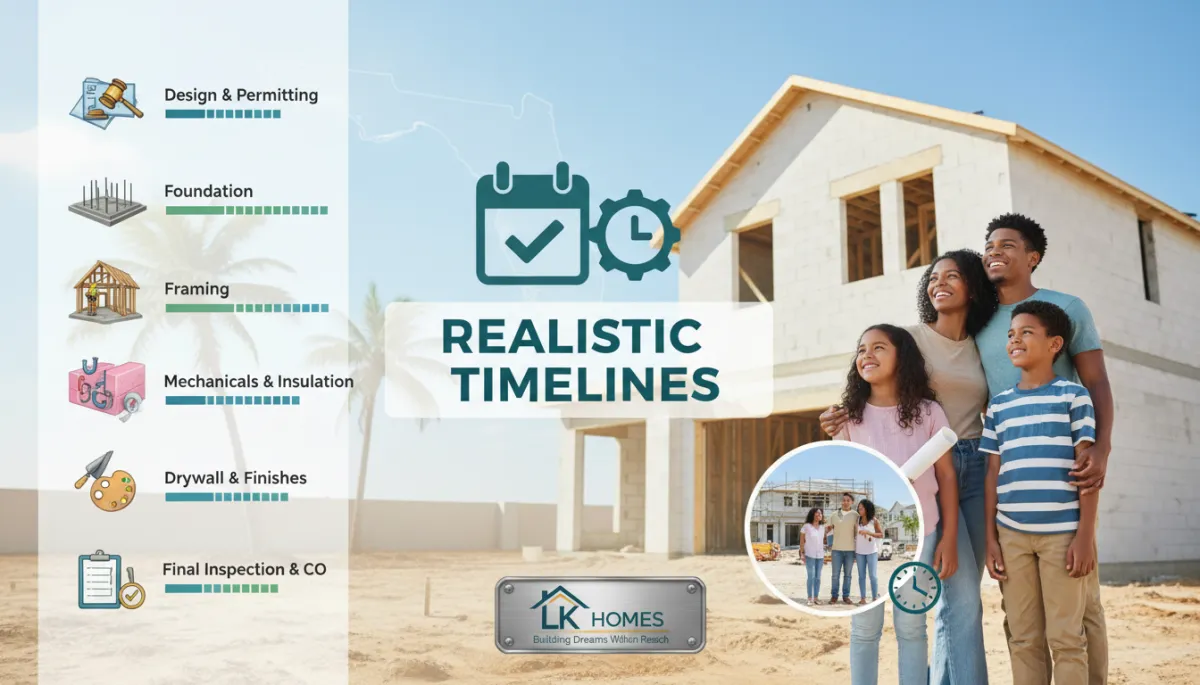
Building a New Home in Florida: Timeline Guide
Home Building, Florida New Construction, Timelines
How Long Does It Take to Build a New Home in Florida?
If you are planning a new construction home in Florida, you are probably asking one big question: “How long will this really take?” Your move-out dates, lease renewals, and even school plans often depend on the answer. At LK Homes, we believe you deserve an honest, realistic timeline—not a best‑case promise that falls apart halfway through the build.
The Short Answer: How Long Does It Take to Build a Home in Florida?
For a typical new construction home in Florida, a realistic permit-to-move‑in timeline runs about 8–14 months, depending on the size, complexity, finishes, and—most importantly—the builder’s process and subcontractor relationships. When you add the pre‑construction work that happens before a shovel hits the ground, you should expect a total journey of roughly 10–18 months from first design meeting to keys in hand for most custom and semi‑custom homes.
That range may sound wide, but it reflects real life in Florida: permitting rules, hurricane season, labor shortages, and your own decision‑making all play a role. The good news is that with the right builder and a clear plan, you can understand what to expect at every step and avoid the horror‑story delays you may have heard about.
Big Picture: Florida’s 2025–2026 Construction Environment
Florida’s homebuilding landscape in 2025 is more stable than it was a few years ago, but it is still tight. Here are three realities that directly affect your timeline:
Permits are moving faster. Median permit processing times have improved to around 25 days in 2025, down from roughly 38 days in 2023 in many jurisdictions. That is great news—but complex projects or coastal lots can still take longer. For official code requirements, your builder must follow the Florida Building Code, which every county enforces in its own way.
Labor shortages are still real. Across Florida, contractors continue to report difficulty finding qualified trades. Labor shortages remain the single biggest cause of construction delays in 2025. When framers, electricians, or drywall crews are stretched thin, schedules slip—especially for builders without strong, long‑term subcontractor relationships.
Material lead times have mostly stabilized. The supply chain chaos of 2021–2023 has eased. Most standard materials arrive on predictable schedules, though windows, doors, and electrical panels are still among the longest‑lead items. When these are ordered early and correctly, they rarely derail a project; when they are not, they can stop a job cold.
In other words: the environment is manageable—if your builder plans for it honestly, instead of pretending every day will be perfect.
Phase 1: Pre‑Construction (2–4 Months Before Groundbreaking)
Before you see any dirt move, there is a surprising amount of work that must be done behind the scenes. This pre‑construction phase typically adds 2–4 months to your overall timeline and includes:
Initial design and budgeting: Floor plan selection or custom design, structural decisions (wood frame vs. ICF), and preliminary pricing.
Engineering and plans: Structural engineering, energy calculations, and site plans that meet Florida Building Code and local ordinances.
Selections and specifications: Making early choices on windows, doors, roofing, and major systems so they can be priced and ordered correctly.
Financing and contracts: Construction‑to‑perm loans, appraisals, and final contract signing with your builder.
📌 Key Takeaway: A home that starts with rushed or incomplete plans almost always takes longer to finish. Time invested here saves time later.
Phase 2: Permitting in Florida (3–8 Weeks on Average)
Once plans are complete, your builder submits them for permits. In 2025, many Florida jurisdictions have improved to a median of about 25 days for standard residential permits. However, real‑world timing can range from 3–8 weeks depending on:
County or city workload and staffing levels
Location‑specific issues like coastal wind zones, floodplains, or environmental reviews
Whether plans are clean and code‑compliant the first time, or need revisions
Your builder must coordinate with local building departments that enforce the Florida Building Code. At LK Homes, we factor realistic permit times into your schedule and update you if the jurisdiction requests changes. We would rather tell you “we expect 4–6 weeks” and deliver in three than promise two and leave you in limbo.
Phase 3: Site Preparation and Foundation (3–6 Weeks)
With permits approved, construction begins on site. In Florida, site prep and foundation usually take 3–6 weeks, including:
Clearing vegetation and debris, grading, and establishing proper drainage
Setting forms and pouring the slab or stem wall foundation to meet code
Required inspections before and after concrete placement
Common delay drivers: heavy rain, unexpected soil conditions, or inspection backlogs. During hurricane season (June–November), we build in weather contingency days rather than pretending every week will be sunny and dry.
Phase 4: Framing and Structural Shell (4–10 Weeks)
Next comes the “skeleton” of your home. For most Florida houses, framing and structural shell take 4–10 weeks, depending on size, complexity, and the wall system you choose:
Wood frame: Traditional stick framing is flexible but can be more labor‑intensive, which matters in a labor‑short market.
ICF (Insulated Concrete Forms): ICF construction can reduce framing and rough‑in time compared to wood frame because the wall system is highly efficient and combines structure, insulation, and formwork in one step.
At this stage, you will see walls, roof trusses, and sheathing go up. You will also have critical inspections for structural components and tie‑downs that meet Florida’s wind and hurricane requirements.
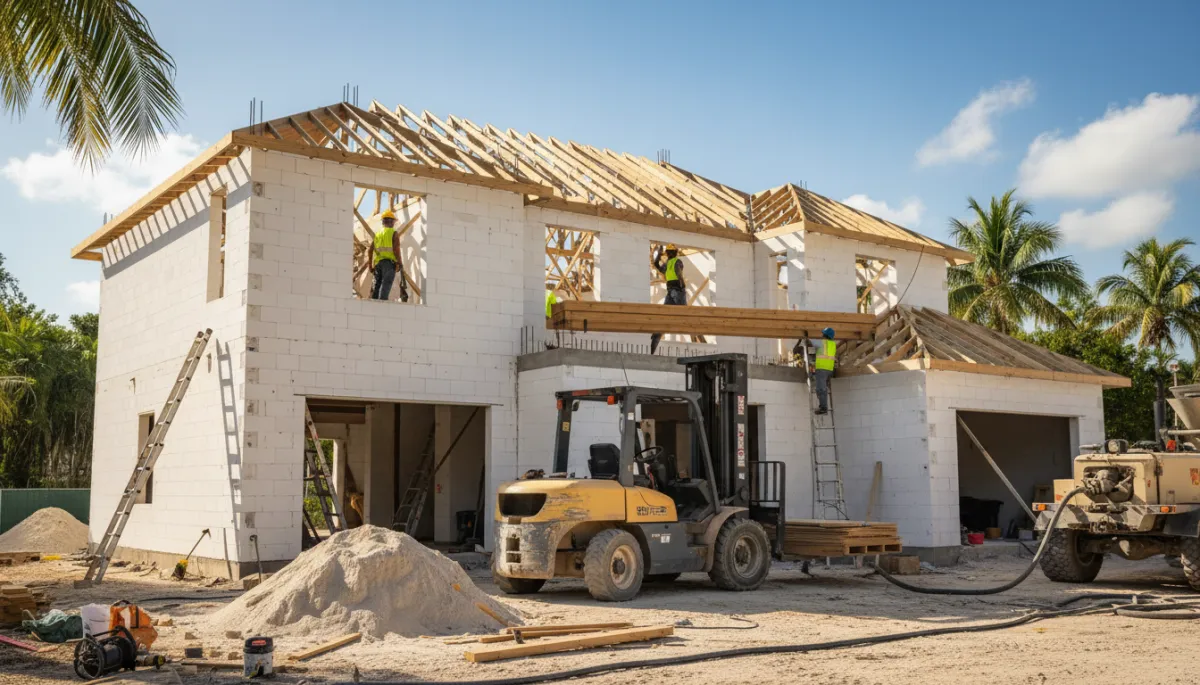
Efficient wall systems and clear scheduling help this Florida build stay on track.
Phase 5: Mechanical Rough‑Ins (3–6 Weeks)
Once the shell is dried in, the “hidden” systems go into the walls and ceilings. This rough‑in phase usually takes 3–6 weeks and includes:
Plumbing supply and drain lines
Electrical wiring, panels, and low‑voltage cabling
HVAC ductwork and air handlers
Key delay drivers: labor shortages in trades (especially electricians and HVAC crews) and late‑ordered long‑lead items like electrical panels. This is where a builder with strong subcontractor relationships and early purchasing strategies can keep you on schedule, even when the market is busy.
Phase 6: Insulation, Drywall, and Exterior Finishes (4–8 Weeks)
After rough‑ins pass inspection, your home starts feeling real. Insulation, drywall, and exterior finishes typically take 4–8 weeks combined:
Insulation installed per Florida energy code and your comfort goals
Hanging, taping, and finishing drywall; exterior stucco or siding work
Windows and exterior doors installed, if they have not been already
Because windows and doors remain some of the longest lead‑time materials, LK Homes orders them early in the process and builds schedule assumptions around realistic delivery dates—not wishful thinking.
Phase 7: Interior Finishes and Trim (6–10 Weeks)
This is the stage most homeowners are excited about—and the stage that can easily run long if decisions or materials change midstream. Interior finishes usually take 6–10 weeks and include:
Interior doors, trim, and baseboards
Cabinets, countertops, and tile work in kitchens and baths
Flooring, interior paint, and decorative fixtures
Mid‑build change orders are the number one client‑driven cause of delays. Swapping cabinets after they are ordered, moving walls once rough‑ins are complete, or changing tile selections late in the game can ripple through the schedule by weeks. LK Homes works hard to finalize selections early and walk you through the impacts of any changes before you approve them.
Phase 8: Final Inspections, Punch List, and Certificate of Occupancy (2–4 Weeks)
As your home nears completion, your builder will schedule final inspections with the local building department to obtain your Certificate of Occupancy (CO). This final phase typically takes 2–4 weeks and includes:
Final trade inspections (electrical, plumbing, mechanical) and building inspection
Punch‑list work to address small items like paint touch‑ups or hardware adjustments
CO issuance, which legally allows you to move in
Inspections are scheduled through your local authority and must comply with Florida Building Code. Your builder should know how to prepare for them and how to respond quickly if any re‑inspection is required.
💡 Pro Tip: Start planning movers, furniture deliveries, and utility transfers only after your builder confirms the inspection schedule and expected CO window—not just the “substantial completion” date.
Why Many Florida Builders Give Overly Optimistic Timelines (A Builder’s Honest Take)
Speaking frankly as a Florida builder: most unrealistic timelines start at the sales table. When a homeowner asks, “Can you do it in six months?” it is tempting to say yes—especially if another builder already did. No one wants to be the one who says, “Realistically, it is closer to ten months,” and risk losing the job.
But optimism does not pour concrete, hang drywall, or get electricians to your job when there are more projects than people. In Florida, the real drivers of delays are:
Labor shortages in key trades, especially when builders rely on whichever subcontractor is cheapest this month rather than long‑term partners.
Poor sequencing and planning, like scheduling drywall before windows are on site or before rough‑ins are fully inspected.
Slow decision‑making and late change orders that force rework or re‑ordering of materials with long lead times.
Underestimating permitting and inspections, especially in coastal or environmentally sensitive areas.
At LK Homes, our philosophy is simple: we would rather lose a job than win it on a promise we know is unlikely. That is why every client receives a detailed construction schedule before breaking ground, with realistic durations for each phase and clear assumptions about permitting, weather, and inspections.
A Florida Family’s Story: From 6‑Month Promise to 14‑Month Reality
When the Martinez family decided to build their first home in Central Florida, they were told it would be a “quick” six‑month build. They ended their lease, moved into a small rental, and timed their kids’ school transfer around that date. It sounded perfect—until reality set in.
Permits took longer than promised. The framing crew was delayed by another job. Windows were ordered late. The builder rarely updated them unless they called in a panic. Six months came and went. Then nine. Their “six‑month” build ultimately took 14 months. They paid for months of unexpected temporary housing, storage, and emotional stress—simply because the original timeline was never realistic.
A few years later, the Martinezes wanted to build again—this time on a larger lot they had purchased. They came to LK Homes with one non‑negotiable: “We need the truth about how long this will take.” After reviewing their plans, lot conditions, and permitting jurisdiction, we presented an honest schedule: approximately 11 months from permit to CO, plus 3–4 months for design and pre‑construction. Not the fastest, not the slowest—but grounded in how projects actually run in Florida today.
We walked them through the schedule line by line, highlighted where delays most often occur, and built in modest buffers for inspections and weather. Throughout the build, our team communicated proactively—sending updates when we passed key milestones and when we saw potential schedule risks. Their second home with LK Homes was completed within two weeks of the original estimate. Their lease end, school plans, and move‑in date stayed aligned all the way through.
📌 What changed? Not Florida’s weather, not the labor market—just the builder’s honesty, planning, and communication.
Six Ways You Can Help Keep Your Florida Build on Schedule
As a homeowner, you have more control over your timeline than you might think. Here are six practical steps you can take to help your Florida new construction stay on track:
Make design decisions early. Finalize your floor plan, structural options, and major design choices before permits are submitted. The more defined your home is up front, the fewer surprises and delays down the road—especially with long‑lead items like windows, doors, and specialty fixtures.
Avoid mid‑build changes. Remember: mid‑build change orders are the number one client‑driven cause of delays. If you are unsure about a selection, ask to see samples, photos, or even similar completed homes before you sign off. A week spent deciding now is better than a month lost to re‑ordering later.
Choose a builder with established subcontractor relationships. In a labor‑tight Florida market, builders who treat trades as long‑term partners—rather than rotating the lowest bidder—are more likely to have crews show up on time and stay on your job until it is done. Ask your builder how long they have worked with their core trades and how they handle scheduling conflicts.
Understand permit timing in your area. Talk with your builder about realistic permit expectations for your specific county or city and any factors—like coastal zones or HOAs—that might add time. Realistic expectations reduce anxiety while you are waiting to break ground and help you plan your housing situation accordingly.
Have financing in place before construction starts. Delays in loan approvals, appraisals, or draws can stall a project even when crews are ready to work. Get your construction financing fully approved, understand the draw schedule, and respond quickly to any documentation requests from your lender.
Build buffer time into your lease or temporary housing plan. Even with the best planning, construction is not a factory line. Weather, inspections, or a delayed delivery can push a schedule by a week or two. Give yourself breathing room—aim to have at least 30–60 days of overlap between your expected completion date and the end of your lease or temporary housing whenever possible.
Rethinking the Question: It’s Not Just “How Long?” but “Built How Well?”
It is natural to focus on the calendar—especially if you are juggling leases, school years, or a home sale. But after building and watching hundreds of Florida homes, we can say this with confidence: a home built right on a realistic schedule is worth far more than a home rushed to hit an artificial deadline.
Families who understand this tend to be happier in their homes long‑term. They experience fewer warranty issues, less stress during construction, and more confidence that their home was built to handle Florida’s heat, humidity, and storms. They see the schedule as a tool for quality and planning—not a race to the finish line at any cost.
“Building Dreams Within Reach” at LK Homes does not mean cutting corners or pretending the market is easier than it is. It means telling you the truth about what it takes to build a solid, comfortable Florida home—and then walking that journey with you, step by step.
Why LK Homes Is Different: Honest Timelines, Clear Communication
As a new construction specialist serving Florida, LK Homes is built around one core belief: you can handle the truth about your timeline—what you cannot handle is being surprised. That is why we:
Provide a detailed construction schedule before breaking ground, phase by phase, with clear time ranges and assumptions.
Explain where delays are most likely—labor, inspections, weather—so you can plan your living situation with realistic buffers.
Maintain strong, long‑term relationships with trusted subcontractors to help navigate ongoing labor shortages.
Order long‑lead materials early and track them closely, especially windows, doors, and electrical components.
Communicate proactively throughout the build—so you hear from us before you feel the need to ask, “What’s going on?”
We know you are not just building a house—you are planning a life move. Our job is to give you the clarity and confidence to do that without guessing.
FAQ: Florida New Home Construction Timelines
1. What is the average time to build a new home in Florida in 2025?
For most custom and semi‑custom homes, a realistic permit‑to‑CO timeline is 8–14 months. When you include design, engineering, and permitting before construction, expect roughly 10–18 months total. Simpler production homes can be faster; highly customized homes can take longer. LK Homes will place your specific project on that spectrum based on size, complexity, and location.
2. Can a Florida home really be built in six months?
In some cases—usually smaller, simpler production homes on builder‑owned lots—a six‑month build is possible. For most custom or semi‑custom homes on your own land, six months is an aggressive best‑case scenario, not a realistic promise. When you hear six months, ask exactly what is included, how permitting and inspections are accounted for, and what happens if labor or material delays occur.
3. How do Florida labor shortages affect my construction schedule?
Labor shortages remain the number one schedule risk in Florida. When trades are booked out, a missed start date can push work by weeks. Builders who plan ahead, maintain strong subcontractor relationships, and avoid over‑booking projects are better positioned to keep your timeline on track. Ask your builder how they schedule trades and what happens if a crew is delayed.
4. Does using ICF or other advanced systems speed up construction?
ICF (Insulated Concrete Forms) can reduce framing and rough‑in time because the wall system combines structure and insulation in one efficient process. That said, total schedule savings depend on your builder’s experience with ICF, the availability of trained crews, and how early materials are ordered. LK Homes can walk you through how ICF would affect both your timeline and long‑term performance in your specific project.
5. How should I plan my lease or temporary housing around a new build?
The safest approach is to build in a 30–60 day buffer between your expected completion/CO date and the end of your lease or temporary housing. Even well‑managed projects can see small shifts due to inspections or weather. LK Homes will help you understand the most likely completion window and update you as the build progresses so you can make informed decisions about move‑out and move‑in dates.
Ready to Talk About Your Florida Build Timeline?
If you are considering building a new home in Florida and want a clear, honest picture of how long it will take—not just a sales pitch—LK Homes is here to help. We will review your land, your wish list, and your timing needs, then outline a realistic new home construction timeline for Florida in 2025 and beyond that you can actually plan your life around.
Schedule a free consultation with LK Homes today to discuss your lot, your ideas, and your ideal move‑in window. Together, we will create a Florida home construction schedule that respects your time, your budget, and your peace of mind—so your new home truly feels like a dream built within reach.
