Custom Home Costs in Florida 2025: A Detailed Guide
New Construction Florida, Custom Home Costs 2025
How Much Does It Cost to Build a Custom Home in Florida in 2025?
If you’re asking, “What will it really cost to build my custom home in Florida in 2025?” you’re not looking for fluffy ranges or sales talk. You want hard numbers, what drives them, and whether building new makes financial sense compared to buying an existing home. That’s exactly what we’re going to walk through here, line by line, the way we do with clients at LK Homes every week.
The Real 2025 Numbers: Cost Per Square Foot in Florida
Let’s start with the question everyone types into Google: “How much does it cost to build a house in Florida in 2025?” Across reputable industry sources, the consensus is clear: expect roughly $150 to $350 per square foot for new home construction in Florida in 2025, depending on location, design, and finish level.1,2 That aligns with what we see every day on the ground as a custom home builder.
For a custom home, not a bare-bones spec build, a realistic working range is:
Basic custom: ~$150–$200/sq ft (simpler plans, modest finishes)
Mid-range custom: ~$200–$250/sq ft (what most of our clients end up in)
High-end custom: ~$250–$350+/sq ft (complex design, high-end finishes, coastal requirements)
These numbers are construction cost only. They do not include land, design, closing costs, or furnishings. Anyone quoting you a “total home cost” that quietly mixes or omits those items is setting you up for sticker shock later.
Where Your Money Actually Goes: Florida Custom Home Cost Breakdown
Every dollar in your budget lands in one of a few buckets. Here’s how we walk clients through it at LK Homes, and how each line item moves the final number up or down.
1. Land and Lot Condition
Land is outside the per-square-foot construction cost, but it’s the first big decision. Florida adds roughly 467,000 new residents a year, which keeps land and housing demand high. Prime infill lots or coastal parcels cost more, and the lot’s condition can add or save tens of thousands:
Clear, flat lot with utilities at the street: lowest site-prep cost.
Heavily wooded, low, or wet lot: expect tree removal, fill, and possibly drainage systems that can easily add $10,000–$40,000+.
2. Site Prep and Foundation
In Florida, your foundation is non-negotiable. Between our soils and hurricanes, cutting corners here is asking for trouble. Costs include clearing, grading, soil testing, engineering, and the slab or raised foundation itself. On a typical 2,200–2,600 sq ft home, this might run 10–15% of the construction budget, and more if the site is challenging or in a flood zone that requires elevation.
3. Framing, Wall System, and Structural Shell
This is where your choice of conventional block/wood vs. ICF vs. steel shows up. Traditional block and wood framing are still common. At LK Homes, we also offer ICF (Insulated Concrete Forms) and steel options because of their performance in Florida’s climate and insurance environment.
ICF typically adds about 3–5% to upfront construction cost compared to a standard wall system. But in return, our clients routinely see 50–60% lower monthly energy bills and a tighter, quieter, more storm-resilient home. When insurance companies and underwriters look at risk in Florida, that matters more every year.
4. Mechanical, Electrical, and Plumbing (MEP)
MEP is often 15–20% of the build cost. In Florida, HVAC sizing and duct design are critical. Oversized or poorly designed systems waste energy and struggle with humidity. Upgrading to higher-SEER equipment, dehumidification, and smart zoning costs more upfront but pays back in operating cost and comfort. Plumbing and electrical costs climb with complexity: extra bathrooms, outdoor kitchens, whole-house generators, EV chargers, and smart-home systems all add line items.
5. Insulation, Windows, and Building Envelope
Florida’s energy code and the Florida Building Code push you toward better insulation and impact-rated openings, especially in wind-borne debris regions. You can meet minimum code with basic options, or you can invest in:
Impact windows and doors instead of shutters
Upgraded roof underlayments and insulation for better energy performance
These upgrades can bump construction cost a few percentage points, but they directly affect comfort, energy usage, and insurance discussions for decades.
6. Roofing and Roof Design
Roofs are a big swing factor. A simple low-pitch shingle roof is the least expensive. Start adding hips, valleys, steep pitches, and switching to metal or tile, and you can add tens of thousands. The trade-off: better looks, better durability, and often better wind performance. In coastal or hurricane-prone areas, we frequently recommend stepping up roof systems because that’s where storms do their worst damage.
7. Interior Finishes and Fixtures
This is where budgets can quietly explode. Cabinets, countertops, flooring, tile, plumbing fixtures, lighting, and trim can swing your project $50,000–$150,000+ depending on choices. The difference between level-one and level-three finishes across a whole house is massive. At LK Homes, we show you real allowance numbers tied to actual product lines so you understand exactly what “mid-range finishes” really mean in a showroom, not just on a spreadsheet.
8. Landscaping, Driveways, and Exterior Details
Basic sod, a concrete driveway, and minimal plantings are one level of cost. Add pavers, irrigation, mature landscaping, fencing, and outdoor living features, and you can easily add $15,000–$75,000+ depending on your vision. We treat this as a defined budget line early so it doesn’t become an afterthought that blows up your total spend at the end.
9. Permits, Impact Fees, and Soft Costs
The good news: permit processing times in Florida have improved—the median is now about 25 days in 2025, down from 38 days in 2023, according to recent permit data from the U.S. Census Bureau. That helps your schedule, but not your line items. You still need to budget for:
Building permits and plan review fees
Impact fees (which vary dramatically by county and city)
Surveys, engineering, and sometimes architectural design if you’re not using a stock plan
We fold all of this into your total budget from day one so you’re not “discovering” five-figure soft costs halfway through.
10. Builder Fees and Project Management
This is where a lot of online estimates go silent. Every legitimate builder charges a fee to manage the project, carry overhead, coordinate trades, and stand behind the work. At LK Homes, our pricing is transparent: you see what’s going to trades and materials and what’s going to builder fees. We build to a higher standard, including ICF and steel options, and we’re upfront that we compete on long-term value, not being the cheapest bid on paper.
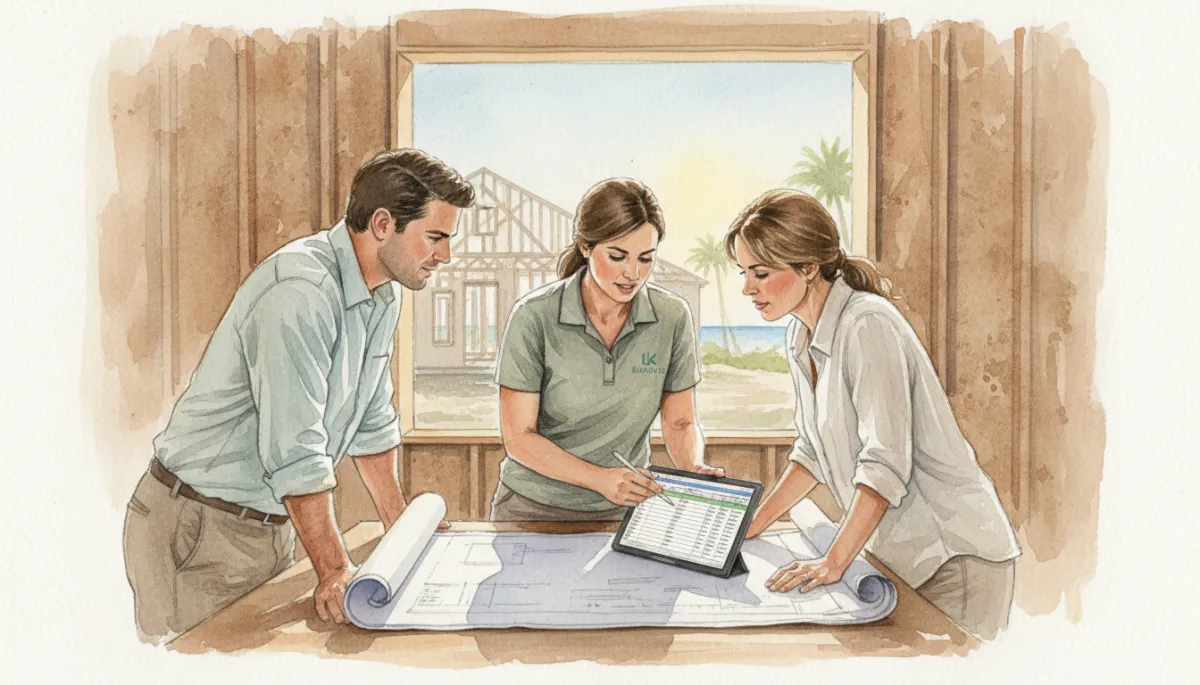
Clear line-item budgets prevent surprises and keep custom homes on financial track.
Florida’s 2025 Construction Landscape: Stabilizing, Not Cheap
Florida’s construction market in 2025 is in a different place than the chaos of 2021–2023. Material spikes have cooled; we’re not seeing lumber triple overnight anymore. Multiple industry indexes show moderate increases now instead of runaway pricing. In other words, the market is stabilizing, not dropping back to pre-2020 levels—and it probably never will.
The biggest persistent pressure is labor. Florida’s ongoing population growth and steady construction activity mean skilled trades are busy, and that keeps labor costs elevated. That’s not something a builder can “value engineer” away without cutting corners on who’s actually swinging the hammer on your home.
Builder’s Take: Why Most Online Cost Estimates Miss the Mark
I’ve lost count of how many times someone has walked into our office with a printout from an online calculator saying they can build their dream home for, say, $165 per square foot—all in. Then we sit down, go line by line, and that number falls apart in about five minutes.
Here’s what most of those tools and “national average” articles get wrong:
They mix production builder pricing (same plan, same finishes, volume discounts) with true custom work.
They ignore Florida-specific code, wind, and flood requirements that add cost compared to other states.
They understate or omit site work, impact fees, and utility connections.
They assume builder-grade finishes that don’t match what most real families actually want to live with.
I’m not saying those tools are useless. They’re fine for rough orientation. But if you’re serious about building in 2025, you need numbers based on your lot, your plan, and Florida’s actual codes and market—otherwise you’re making six-figure decisions off fantasy pricing.
Seven Decisions That Move the Needle Most on Florida Custom Home Cost
After hundreds of projects, we can tell you exactly which decisions have the biggest impact on your final number. If you manage these seven well, you keep control of your budget without gutting quality.
Lot condition: A “cheap” lot that needs $40,000 in fill and drainage is not cheap. Get a builder to walk the lot before you buy. We do this routinely for LK Homes clients so they know what they’re really signing up for.
Foundation type: Slab-on-grade vs. elevated slab vs. stem wall in a flood zone are three very different numbers. Your flood zone and local requirements may make this decision for you; don’t ignore it when budgeting.
Wall system: Block, wood, ICF, or steel. ICF adds that 3–5% upfront but can dramatically reduce lifetime operating and maintenance costs. If you plan to hold the home long-term, this one decision can be a wealth-building move, not just a line item.
Roof pitch and material: Keep the roof simple and use dimensional shingles if you need to tighten the budget. If you can stretch, metal or tile plus a better underlayment can be a smart long-horizon investment in Florida’s storm environment.
Square footage allocation: Bigger is not always better. Wasted hallways, oversized formal rooms you’ll never use, and unnecessary second stories all add cost without adding real life value. We’d rather design 2,200 efficient square feet that live like 2,600 than sell you 3,000 bloated square feet that strain your budget and your utility bills.
Finish level: You don’t need level-three everything. Pick your “hero” areas—kitchen, primary bath, main living floors—and keep secondary spaces simpler. That’s how you get a home that feels high-end where it counts without blowing the budget everywhere else.
Builder selection: The cheapest bid is almost never the cheapest final cost. Change orders, delays, rework, and lack of coordination eat money. LK Homes handles design, permitting, and build under one roof, which cuts down on finger-pointing and surprises.
💡 Pro Tip: Before you obsess over cabinet door styles, lock in your lot, structure, and roof decisions. Those three will move your budget more than any faucet will.
A Real Florida Story: From Online Fantasy Budget to a Home That Actually Worked
When the Ramirez family came to us, they had done their homework—or so they thought. They’d plugged their dream 2,600 sq ft, 4-bedroom plan into an online calculator that told them they could build for around $420,000 total, including land. They had a lot under contract on the Gulf Coast and were excited—and nervous—when they sat down at our table at LK Homes.
We didn’t sugar coat it. Based on their lot (which needed fill and a stem-wall foundation), their desired finishes, and current new construction cost per square foot in Florida, their actual all-in number was closer to the mid-$600s. The online tool had missed:
Site work and elevation required for their flood zone
Impact windows and doors required by local code
Realistic allowances for the level of finishes they showed us on Pinterest
It was a tough conversation. We’d rather have that conversation at the beginning than at the closing table. Instead of walking away, the Ramirez family decided they wanted a home that fit their actual life, not a fantasy budget. Together, we:
Trimmed the plan to 2,300 very efficient square feet by reworking hallways and unused formal space
Chose ICF walls and a simpler roofline to control long-term insurance and energy costs
Focused their finish upgrades in the kitchen and primary suite, keeping secondary bedrooms modest
The final build number still wasn’t $420,000—and we never pretended it would be. But it was a home they could finance, live in comfortably, and afford to operate, with energy bills more than 50% lower than their previous rental. That’s the difference between chasing a low online estimate and working through real Florida numbers with a builder who tells you the truth.
Build vs. Buy in Florida 2025: Which Makes More Financial Sense?
With Florida’s resale market still tight and prices elevated, a lot of families are weighing build vs buy in Florida 2025. Buying an existing home might look cheaper at first glance, but here’s what you’re really comparing:
Existing homes often come with older roofs, older mechanicals, and older construction standards. In our insurance and hurricane environment, that matters. You may save on purchase price and lose on repairs, premiums, and headaches.
Building new with LK Homes means full control over layout, finishes, and construction method—ICF, steel, and upgraded roofing options that are designed for where Florida is headed, not where it was 20 years ago.
In a state where insurance and energy costs are climbing, a custom home built to a higher standard can be the more predictable, controllable financial move over a 10–20 year horizon, even if the sticker price is higher than a 1990s resale down the street.
Reframing the Cost: Your Custom Home as a Wealth-Building Decision
Too many people treat a custom home like a one-time “expense” to minimize. That mindset leads straight to the cheapest builder, the lowest bid, and the most corners cut. In Florida, that’s a dangerous game. The right way to look at it is simple:
Your home is likely your largest single asset.
You control every major decision about how it’s designed and built when you go custom.
Those decisions affect resale value, operating costs, and risk for decades.
A custom home built to the right standard in Florida is not just “more expensive.” It’s the most controllable wealth-building decision most families ever make. You can’t control the stock market. You can’t control interest rates. But you can control:
Whether your walls are basic block or energy-efficient ICF
Whether your roof is barely code-minimum or designed for the storms we actually get
Whether your layout wastes space or supports the way your family truly lives
At LK Homes, our brand promise is “Building Dreams Within Reach.” That doesn’t mean building the cheapest house we can. It means designing and building homes that make financial and practical sense for real Florida families—homes that stand up to this climate and this market, not just to a bank appraisal on day one.
FAQs: Cost to Build a Custom Home in Florida in 2025
1. What is a realistic budget per square foot for a custom home in Florida in 2025?
For true custom homes—not production builds—you should plan on roughly $200–$250 per square foot for a well-finished, mid-range home in most Florida markets, with total ranges from $150 to $350 per square foot depending on finishes, design complexity, and location. That number is for construction only and does not include land or closing costs. We’ll refine that range for your specific project once we know your lot and wish list.
2. Does building with ICF or steel really cost more, and is it worth it?
Yes, ICF typically adds about 3–5% to upfront construction cost compared to standard wall systems. But in return, most homeowners see 50–60% lower monthly energy bills, better sound control, and stronger storm performance. In a state where energy and insurance costs are climbing, that extra investment often pays for itself and then some over the life of the home. Steel and other advanced systems follow the same logic: higher build quality, lower long-term risk and operating cost.
3. How long does it take to build a custom home in Florida in 2025?
For a typical 2,000–2,800 sq ft custom home, you’re usually looking at 10–16 months from final design to move-in, depending on jurisdiction, complexity, and weather. The good news is that permit processing times have improved—median around 25 days in 2025—so more of that timeline is actual construction, not just waiting on paperwork. At LK Homes, we handle design, permitting, and build, which helps keep that schedule tighter and more predictable.
4. Is it cheaper to buy an existing home or build new in Florida right now?
On paper, an older existing home may show a lower purchase price per square foot than building new. But that doesn’t factor in deferred maintenance, older systems, higher insurance premiums, and higher energy bills. Building new with LK Homes means you get current-code construction, modern systems, and the ability to choose energy-efficient and storm-resilient options like ICF and upgraded roofing. Over a 10–20 year period, that can make new construction the smarter financial move, even if the upfront sticker price is higher.
5. How do I get an honest, project-specific cost estimate from LK Homes?
We start with a free, no-pressure consultation. You bring your ideas, lot information (or target area), and any plans or inspiration you have. We walk you through realistic 2025 pricing based on current Florida conditions, your desired size and finish level, and your preferred construction method. Then we build a line-item budget—not a guess—so you can see exactly where every dollar is going before you commit.
Ready for Real Numbers on Your Florida Custom Home?
If you’re serious about building in Florida and you’re tired of vague online calculators and lowball estimates, it’s time to talk to a builder who will respect your intelligence—and your budget. LK Homes builds custom new construction across Florida, handling design, permitting, and construction under one roof, with honest pricing from day one and no surprises at closing.
Schedule your free consultation today and let’s find out what it will really cost to build the home you actually want, on the lot you actually own, in the Florida market we’re all living in right now.
