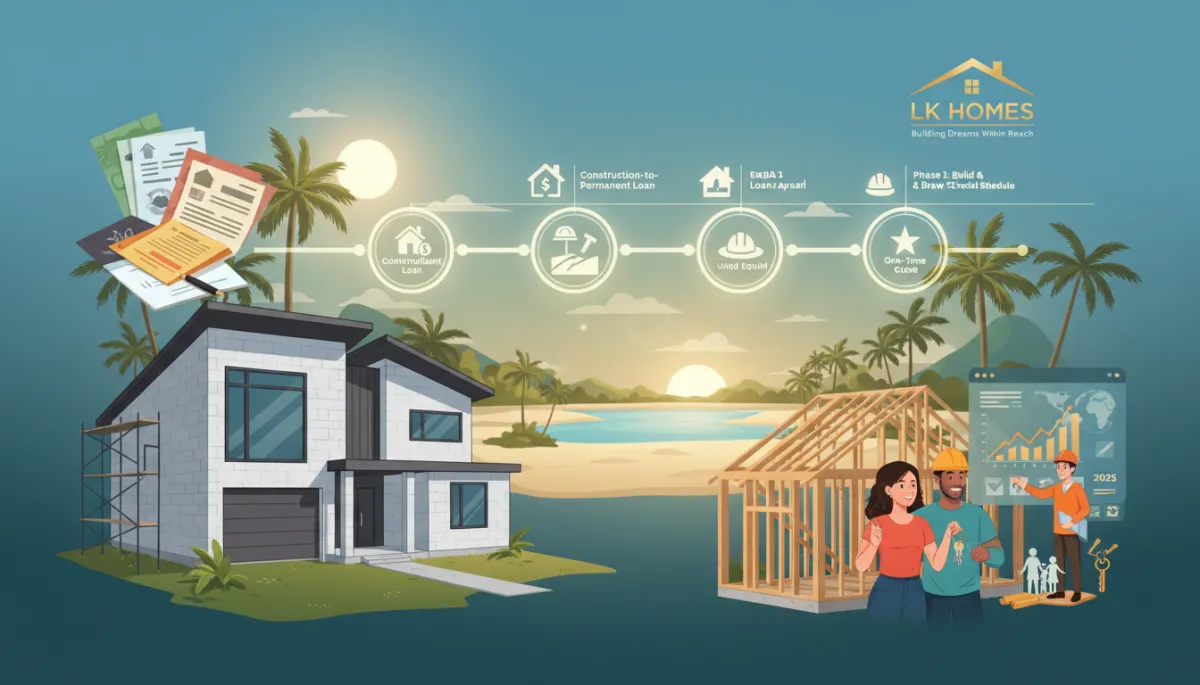
Finance Your New Florida Home in 2025
Florida Construction Loans, New Home Financing, LK Homes
How to Finance a New Construction Home in Florida in 2025
If you own land in Florida or dream of building a custom home here, the construction side probably excites you. The money side? For most people, that part feels confusing, intimidating, and like the thing that might quietly kill the whole dream. This guide is written to change that. We will walk through every major way to finance a new construction home in Florida in 2025, explain the jargon in plain language, and show you how LK Homes helps you move from “I have no idea where to start” to “We’re breaking ground with confidence.”
Why Financing Is the Step That Stops So Many Florida Builds
Speaking as a builder, we see the same pattern over and over. People spend months picking floor plans, scrolling through inspiration photos, and walking lots. Then they hit the financing stage and everything stalls. Not because they cannot qualify, but because no one has ever taken the time to explain how construction loans really work in Florida, in simple, everyday language.
Financing kills more Florida new construction dreams than any other step, and in our opinion, it is usually avoidable. The problem is not you. The problem is a system that throws around terms like “draw schedules,” “DTI,” and “one-time close” without slowing down to translate. At LK Homes, we believe your builder should explain the money side as clearly as we explain foundations, ICF walls, and roof systems. When you understand your options, financing stops being a barrier and becomes the tool that makes your entire build possible.
The 2025 Florida Lending Environment: Why Now Is a Real Opportunity
After a few years of sharp rate increases and bidding wars, 2025 looks very different. Mortgage rates in Florida have begun to stabilize, with 30‑year fixed rates hovering in the mid‑6% range, and leading forecasters like Fannie Mae expecting gradual easing into 2026. Inventory has improved, and the market has shifted toward a more balanced, buyer‑friendly environment according to Florida Realtors and other industry reports. That means lenders are actively looking for strong, well-structured projects—especially primary homes with solid borrowers and reputable builders.
At the same time, lenders are increasingly comfortable financing non‑traditional, high‑performance construction methods such as insulated concrete forms (ICF) and steel framing, especially when the builder has a track record. LK Homes partners with Florida lenders who understand ICF and steel construction, so our clients do not have to “educate” the bank about why their home is different. That combination—stabilizing rates, more flexible programs, and lenders open to modern building systems—makes 2025 a smart time to move from planning to building if you are ready.
Major Ways to Finance a New Construction Home in Florida in 2025
1. Construction-to-Permanent Loan (One-Time Close)
A construction-to-permanent loan is often the simplest path for a Florida homeowner building a primary residence. You apply once, close once, and the loan pays for the build and then automatically converts into your regular mortgage when the home is finished and you receive the certificate of occupancy. That means:
One set of closing costs instead of two
No need to re-qualify for a separate mortgage at the end of construction
Often the ability to lock your interest rate before you start building
During construction, you typically make interest-only payments on the amount that has been drawn so far, not on the full loan amount. When the home is complete, the loan converts into a standard principal-and-interest mortgage. Many Florida banks, credit unions, and mortgage companies offer this structure, and it is often our first recommendation for primary homes because it keeps the process clean and predictable.
2. Construction-Only (Stand-Alone) Loan
A construction-only loan is short-term financing that covers just the build. When the home is finished, you take out a separate mortgage to pay off the construction loan. This is sometimes called a “two-close” structure because you have two separate closings: one for construction, one for the permanent mortgage. It can make sense if:
You believe rates will be significantly lower by the time your home is finished
You expect your income, credit, or debt situation to improve before you lock in long-term financing
The tradeoff is extra closing costs and the risk that qualification rules may change. If we recommend a construction-only loan, it is always with a clear plan for how you will transition into the permanent mortgage when the build is complete, so you are never left scrambling at the finish line.
3. Owner-Builder Loans
An owner-builder loan is for people who plan to act as their own general contractor instead of hiring a licensed builder. On paper, it can sound appealing—more control, potential cost savings. In reality, these loans are much harder to qualify for in Florida, especially in 2025’s still-cautious lending environment. Most lenders want:
Significant construction experience, or
A licensed contractor overseeing the project anyway
As a builder, our honest view is that owner-builder loans are best for people who are already in the construction industry. For everyone else, working with a qualified builder like LK Homes usually makes it easier to get financing approved, keeps lenders comfortable, and protects you from costly mistakes mid-build.
4. USDA Rural Development Construction Loans in Florida
If you are building in a qualifying rural or “rural-character” area, a USDA Rural Development construction-to-permanent loan can be one of the most powerful tools available. For eligible borrowers and properties, USDA loans can offer 100% financing—no down payment—on a primary residence, even when you are building new. In 2025, income limits for USDA guaranteed loans were updated to around $119,850 for 1–4 person households and higher for larger households, depending on the county and cost of living.
With a USDA one-time-close construction loan, you roll the land (if you are buying it), construction, and permanent mortgage into one package. Payments are typically interest-only during construction, then convert to a 30‑year fixed mortgage. To see if your property or target area qualifies, you can use the official USDA property eligibility map on the USDA Rural Development site. We often walk clients through this step and help them connect with USDA-approved lenders who know the Florida market well.

Many Florida rural and semi-rural lots qualify for 100% USDA construction financing.
5. VA Construction Loans for Florida Veterans
If you are an eligible veteran, active-duty service member, or surviving spouse, a VA construction loan can be an incredible benefit. In Florida, VA construction loans are available through participating lenders and can cover up to 100% of construction costs with no down payment required, subject to VA guidelines and lender overlays. That means you can often:
Finance the land (if needed) and construction together
Pay interest-only during the build
Convert to a standard VA mortgage when the home is complete
The U.S. Department of Veterans Affairs publishes detailed guidance on acceptable construction loans and builder requirements. LK Homes works with VA-approved lenders who understand the specifics of VA construction loans in Florida so that your service benefits are fully used to your advantage, not lost in paperwork confusion.
6. FHA One-Time Close Construction Loans
For buyers who do not qualify for USDA or VA, or who are building in more suburban or urban parts of Florida, an FHA one-time close construction loan can be a strong option. FHA allows you to finance the land purchase and construction together with as little as 3.5% down, assuming you meet FHA credit and income guidelines. It is still a construction-to-permanent structure, so you close once, build, and then automatically convert to a long-term FHA mortgage backed by HUD guidelines.
FHA loans are known for being more flexible on credit scores and debt-to-income ratios than many conventional construction loans. If your credit is in the low 600s or you are rebuilding after a financial setback, this program may keep your build timeline on track instead of forcing you to wait several more years.
7. Using Land Equity as Your Down Payment
One of the most misunderstood pieces of the puzzle is land equity. If you own your lot free and clear—or you have owned it long enough that it has gained value—many Florida construction lenders will allow that equity to count as your down payment. In other words, the value of your land can reduce or even eliminate the cash you need to bring to closing for the construction loan itself (you will still have closing costs and prepaids).
Here is how it usually works in simple terms: the lender orders an appraisal that looks at the “as-completed” value of your finished home on that lot. They also consider the current value of the land. If your land is worth enough relative to the total project cost, your required down payment can be drastically reduced. This is where having a builder who understands how lenders calculate land equity can make a huge difference in how your loan is structured.
8. Other Options: Conventional and Portfolio Construction Loans
Beyond the major government-backed programs, many Florida banks and mortgage companies offer conventional construction loans and specialized portfolio products. These can sometimes go up to 90–95% loan-to-value for strong borrowers, especially on primary residences. They are a good fit if your income and credit are strong, you want to build in a non-rural area, and you prefer a straightforward structure without the extra rules that come with FHA, VA, or USDA.
How LK Homes Guides You Through Financing from Day One
At LK Homes, “Building Dreams Within Reach” is not just a tagline—it shapes how we approach every project. We will never tell you to “go figure out the money and come back when you’re approved.” Instead, we start with a conversation about your goals, your land, your budget, and your comfort level. Then we:
Connect you with Florida lenders who specialize in construction loans, including USDA, VA, FHA one-time close, and conventional programs
Help you understand which loan types match your situation so you are not wasting time on options that do not fit
Structure our build schedule and contract to align with the lender’s draw schedule and inspection requirements
Provide detailed plans, cost breakdowns, and builder documentation that lenders need to issue final approvals
We also follow a simple but powerful rule: we do not start construction until your financing is fully in place. That protects you from being stuck with a half-finished home if something changes mid-build. When you break ground with LK Homes, you do it knowing the funding is lined up from the first shovel of dirt to the final inspection.
Real-World Success: Building with Land Equity and Zero Cash Down (Beyond Closing Costs)
One of our favorite recent stories involves a Florida landowner we will call Maria. She and her husband bought a piece of land outside a growing Gulf Coast town years ago, paying it off slowly over time. By 2025, the lot was owned free and clear, but they assumed building a custom home would still require a huge cash down payment they simply did not have.
When Maria reached out to LK Homes, she opened the call with, “We probably can’t afford this, but I just want to know what it would take.” As we talked, we learned the land had appreciated significantly. We suggested a construction-to-permanent loan that allowed her to use her land equity as the down payment. Working with one of our preferred lenders, we:
Ordered an appraisal on the land and the as-completed home
Structured the loan so the lot’s value satisfied the required down payment
Finalized a build contract that matched the lender’s draw schedule
Maria and her husband ended up breaking ground with zero cash out of pocket beyond closing costs. Their years of owning the land—something they had almost forgotten about—became the key that unlocked their construction financing. Today, they are living in a storm‑resistant, energy‑efficient home tailored exactly to how they want to live, not just what was available on the resale market.
📌 Key Takeaway: If you own land in Florida, especially free and clear, do not assume you need a large cash down payment. Your lot may already be the “down payment” the bank is looking for.
How Construction Loan Draw Schedules and Inspections Work
Unlike a standard mortgage, a construction loan does not hand over all the money on day one. Instead, funds are released in stages called draws. Each draw is tied to a build milestone—such as foundation completion, dried-in shell, mechanical rough‑ins, and final finishes. Before releasing each draw, the lender sends an inspector or uses a third-party service to confirm that the work has been completed as planned.
For you, this protects against paying for work that has not been done. For the lender, it ensures the home is progressing as agreed. For us as the builder, it means we must plan your project schedule and payment milestones to align smoothly with the bank’s process. This is one area where experience matters: LK Homes knows how to structure contracts, provide documentation, and coordinate inspections so that your build keeps moving and subcontractors are paid on time without surprises.
Eight Things Florida Homeowners Must Know Before Applying for a Construction Loan
Credit score expectations. Most Florida construction lenders look for a minimum credit score between 680 and 720, depending on the loan type. FHA may allow lower scores, while conventional and some portfolio loans expect higher. Before you apply, it is worth pulling your credit, fixing errors, and paying down small balances where you can.
Debt-to-income (DTI) ratios. DTI is simply the percentage of your gross monthly income that goes toward debt payments (including the future mortgage). Lenders use it to make sure your new payment will be comfortable, not crushing. Many construction programs aim for a DTI under about 43%–45%, though some FHA and VA loans can be more flexible with strong compensating factors.
How draw schedules really feel day to day. Remember, you are only paying interest on the money that has been disbursed so far. Early in the build, payments are smaller. As more draws are taken and the home nears completion, your interest-only payments increase. We map this out with clients so you are not surprised by the change over time.
Inspection requirements. Lenders generally require inspections at each draw stage. These are separate from county building inspections. They are quick, but they must be scheduled and passed before funds are released. A builder used to construction financing will anticipate this and build it into the schedule instead of treating it as an afterthought.
How land equity is calculated. If you own your lot, the lender will look at its current appraised value, not just what you paid. They compare the total project cost to the as‑completed appraised value. The difference between what you owe on the land (if anything) and what it is worth can count as equity toward your required down payment, often reducing or eliminating cash you need to bring in.
What happens if the build goes over budget. No one plans on cost overruns, but materials and site conditions can change. Lenders typically expect a contingency—extra funds built into the budget. If actual costs exceed the approved budget, you may need to bring in additional cash or adjust the scope. LK Homes works hard up front to build realistic budgets and include sensible contingencies so you are protected if prices move during construction.
How to compare lender offers. Do not just look at the interest rate. Also ask about: fees, rate lock options, how long the construction term lasts, whether the loan is one-time close or two-close, and how flexible they are with ICF or steel construction. A slightly higher rate with better terms can be a smarter choice than the lowest rate with rigid rules that do not fit your project.
Why builder approval matters to the lender. Most Florida construction lenders will review your builder’s license, insurance, experience, and past projects before approving your loan. They want to know the person managing your build has the track record to finish it successfully. Working with a builder like LK Homes—already known to many Florida lenders and experienced with ICF and steel financing—can make your approval process smoother and faster.
Financing as a Tool, Not a Roadblock
It is easy to see financing as the gatekeeper keeping you out of your dream home. From our perspective as a builder, it is the opposite. Financing is the tool that makes your build possible. The families who take the time to understand their options—construction-to-permanent, USDA, VA, FHA one-time close, land equity—are the ones who break ground while everyone else stays stuck in “someday.”
You do not need to become a mortgage expert. You just need a clear explanation, a builder who respects your questions, and a team that knows both sides of the process: the financing and the construction. That is the role LK Homes is built to play for Florida homeowners and landowners—guiding you from big idea to funded, buildable plan, and finally to a finished home you are proud to walk into every day.
Frequently Asked Questions About Financing a New Construction Home in Florida (2025)
1. Do I need a huge down payment to build a home in Florida?
Not necessarily. With USDA rural development loans and VA construction loans, eligible borrowers can often finance up to 100% of construction costs with no down payment. FHA one-time close loans start as low as 3.5% down. If you already own land, its equity can often serve as your down payment, reducing or even eliminating additional cash requirements beyond closing costs. The key is matching your situation to the right program early in the process.
2. Can I use my current lot as my entire down payment?
In many cases, yes. If your land is owned free and clear—or has significant equity—the lender will use an appraisal to determine its current value. That value is then compared to the total project cost and as‑completed value. If the numbers work, your land equity can count as the required down payment. We have helped Florida landowners break ground with no additional cash down beyond closing costs by structuring their loans this way.
3. How long does the construction loan process usually take?
From initial application to closing, most Florida construction loans take 45–60 days, depending on how quickly documents, appraisals, and approvals come together. Working with a builder like LK Homes can shorten the timeline because we already know what lenders need: detailed plans, cost breakdowns, permits, and builder credentials. When those pieces are ready early, your loan can move more smoothly to closing so you can start building sooner.
4. Are lenders really okay with ICF and non-traditional construction methods?
Yes—more than ever. In 2025, many Florida lenders are comfortable with ICF, steel, and other high‑performance systems, especially in hurricane-prone areas where durability and energy efficiency are major advantages. The key is working with a builder and lender who have experience with these methods. LK Homes partners with lenders who regularly finance ICF and steel construction, so your home’s structure is seen as a strength, not a complication.
5. When should I talk to a builder about financing—before or after I talk to a lender?
The best approach is to involve both early. A quick conversation with LK Homes can help clarify your budget range, construction method, and timeline. From there, we can introduce you to lenders whose programs fit your goals. That way, you are not designing a home you cannot finance—or applying for a loan that does not match the home you truly want. Think of the builder and lender as your two key partners; when they work together from day one, your path to approval and construction is much smoother.
Ready to Turn Your Florida Land or Dream Lot into a Finished Home?
If you are serious about building a new construction home in Florida in 2025, you do not have to figure out the financing alone. LK Homes is here to walk you through your options, connect you with trusted lenders, and design a home and build schedule that fit both your lifestyle and your budget. Whether you have owned your lot for years or you are just starting to look, your next step is simple:
Schedule a free consultation with LK Homes to discuss your land, your numbers, and your vision. Together, we will turn financing from a question mark into a clear, confident plan—and start building the Florida home you have been imagining.
