ICF Aircraft Hangars: Florida's Aviation Solution
ICF Construction, Aircraft Hangars, Florida Aviation
ICF Aircraft Hangars in Florida: The Permanent Solution for Serious Aviation Properties
LK Homes builds ICF aircraft hangars across Florida — storm proof, energy efficient, and engineered as permanent infrastructure for serious aviation assets.
1. Why Florida’s Serious Aircraft Owners Are Moving to ICF Hangars
Florida sits near the top of every aviation metric that matters — more than 21,000 registered aircraft, a dense network of public and private airstrips, and one of the most active general aviation communities in the country(aircraftone.com). At the same time, it is also a hurricane state where steel hangars fold and doors fail every storm season. When you are protecting a six or seven figure aircraft, that combination demands a different kind of building — one that behaves more like critical infrastructure than an accessory outbuilding.
Insulated concrete forms (ICF) deliver that standard. Properly engineered ICF hangars are rated to resist 200+ mph winds, provide continuous insulation, and eliminate the weak points that routinely lead to catastrophic hangar failures — especially door blow‑ins and progressive wall collapse. For Florida aircraft owners, fly‑in community residents, and private airstrip property owners, ICF is no longer a niche option. It is the only wall system that can credibly claim to protect an aircraft during a major hurricane while also cutting operating costs year after year.
2. How ICF Applies to Real‑World Hangar Design in Florida
2.1 Primary hangar shell — the structural core
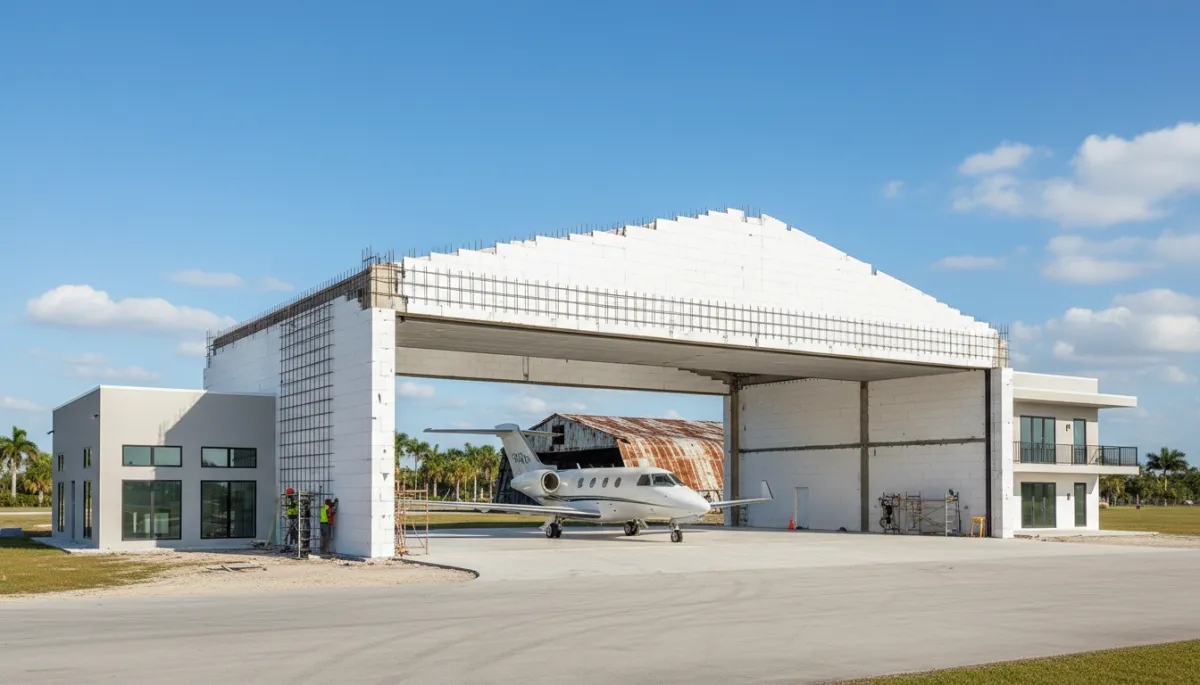
In an ICF hangar, the exterior walls are formed with interlocking foam blocks that are stacked, reinforced with steel, then filled with concrete. The result is a monolithic, steel‑reinforced concrete wall wrapped in insulation. For aviation use, LK Homes designs these walls to:
Resist 200+ mph wind loads with proper reinforcement schedules and connection details
Integrate engineered door jambs for large hydraulic or bi‑fold doors without creating weak points
Provide continuous insulation that stabilizes interior temperatures and reduces condensation on airframes
The roof structure can be steel, pre‑engineered trusses, or a concrete deck depending on span, aircraft tail height, and budget — but the ICF walls remain the structural backbone that keeps the building intact when the weather turns violent.
2.2 Integrated office space and pilot lounges
Most Florida owners do not want a bare box. They want a working aviation base — dispatch office, briefing room, pilot lounge, and storage — often conditioned separately from the main hangar bay. ICF is ideal for these enclosed areas:
Walls between office zones and the hangar can be framed in ICF or conventional framing tied into ICF exteriors, providing fire separation and sound control from engine runs and tugs
Mechanical systems can be right‑sized because the insulated envelope reduces heat gain — a major advantage in Florida’s climate
For pilot lounges and briefing rooms, ICF’s sound attenuation is a practical benefit. Thick concrete cores and foam insulation dampen runway and taxi noise, creating quiet spaces to plan flights or host guests even while the ramp stays active outside.
2.3 Maintenance bays and workshop zones
Maintenance bays demand higher floor load ratings, clear access, and robust fire resistance. ICF contributes in three ways:
Non‑combustible, fire‑resistant walls that help compartmentalize maintenance areas from storage or living quarters
Stable interior temperatures that protect tools, avionics benches, and paint or composite work from humidity swings
Moisture and pest resistance — critical in Florida where termites, rodents, and high humidity can destroy conventional wall systems and wiring over time
2.4 Live‑in hangar homes and airpark residences
Hangar homes — where the residence and hangar share a common structure — are one of the fastest‑growing segments in Florida’s fly‑in communities and residential airparks. ICF is uniquely suited to this hybrid use:
A single ICF shell can wrap both living quarters and aircraft storage, simplifying structural engineering and improving energy performance across the entire building
Fire and sound separation between living space and hangar can be achieved with rated assemblies, strategic wall placement, and dedicated mechanical systems
Owners gain the security of a permanent, hurricane‑resistant structure for both their family and their aircraft under one roof
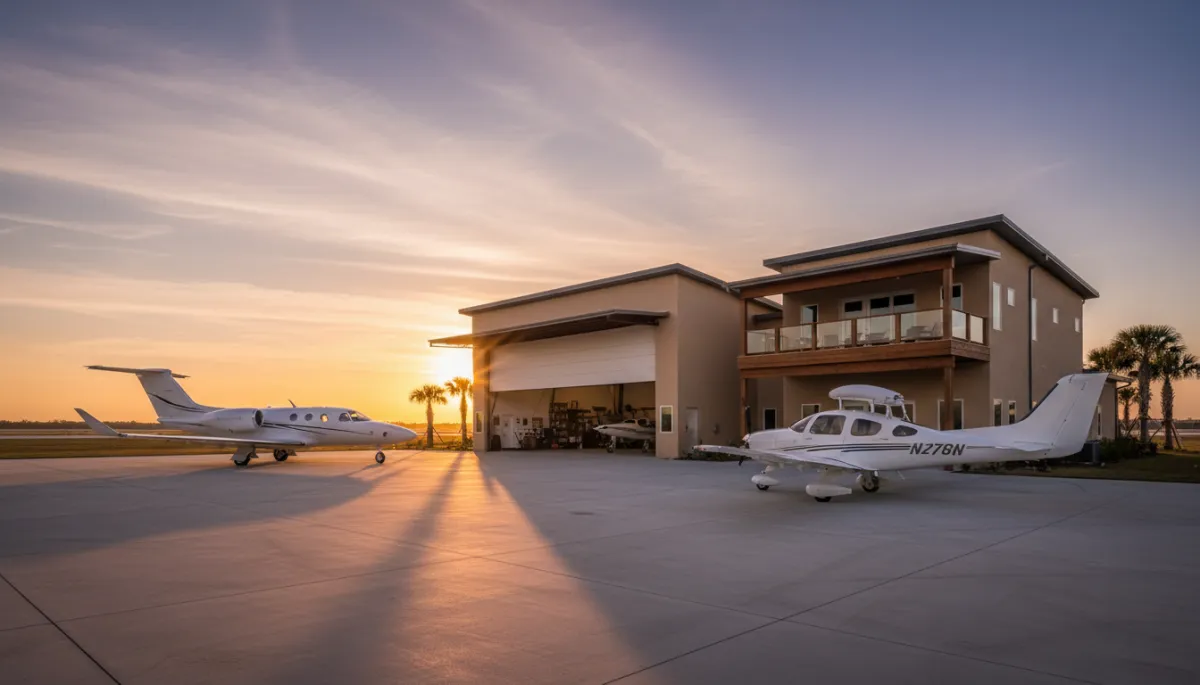
ICF hangar homes combine residential comfort with true hurricane‑rated aircraft protection.
3. LK Homes — Florida’s Dedicated ICF Hangar and Hangar Home Builder
LK Homes is a Florida new‑construction specialist focused on insulated concrete form projects — from custom homes to aviation properties. For aircraft owners, our role is straightforward: design, permit, and build ICF hangars and hangar homes that match the aircraft you own now and the fleet you plan to build over time. We handle the entire process under one roof, coordinating with your airport authority, HOA, and local building department so you do not have to manage multiple vendors who may not understand aviation requirements.
Every hangar layout begins with three variables — aircraft type, operation size, and owner lifestyle. A single‑engine Cirrus SR22 used for business travel demands a different footprint than a turbine helicopter plus two piston trainers or a light jet. We design clear spans, door heights, and apron interface around those specifics, then integrate office space, guest suites, and maintenance zones according to how you actually use your aircraft. For hangar homes, we treat the residence as a full custom home project, not an afterthought attached to a metal box.
📌 Key Takeaway: LK Homes is not adapting a farm‑style steel building to aviation use. We start with aviation requirements, then engineer an ICF structure that meets Florida’s wind codes and your long‑term ownership plans.
4. Storm Reality — A Florida Owner’s ICF Hangar Success Story
During a recent major hurricane, one of our Central Florida clients — a corporate pilot who owns a high‑performance single and a turboprop — faced what every aircraft owner dreads. The storm tracked closer than forecast, winds pushed past 130 knots in gusts, and the local airpark was squarely in the path of the eyewall. His ICF hangar home, designed and built by LK Homes, sat in a row of mostly conventional steel hangars.
After the storm, the pattern was familiar — and painful — across the field. Several steel hangars lost their doors entirely. Once the doors failed, internal pressure and suction peeled roof panels, buckled frames, and in some cases led to full wall collapse. Aircraft that had been meticulously maintained were suddenly exposed to driving rain, flying debris, and structural failures. Insurance claims followed, but some aircraft were total losses and others were grounded for months awaiting repair slots and parts.
The ICF hangar home told a different story. The ICF walls, engineered door frame, and hurricane‑rated hydraulic door system held. The structure rode out the storm with cosmetic damage only — some trim, minor roof components, and landscaping. Inside, both aircraft were dry, secure, and ready to fly once the field reopened. The owner’s comment afterward was simple: “The aircraft were the least of my worries. I knew the building would hold.”
That is what a permanent aviation structure looks like in Florida — not a disposable metal shell, but an ICF core that behaves like a bunker while still delivering a comfortable home and efficient hangar environment day to day.
5. Florida Aviation Trends — Why Permanent Hangars Matter Now
Florida’s aviation ecosystem is expanding on every front. The state supports over 2,000 aviation businesses and more than 125 public‑use airports, with additional private strips and residential airparks layered on top(Florida Department of Transportation Aviation Office). New MRO facilities, aerospace manufacturing, and advanced air mobility projects are drawing more aircraft and more high‑value operations into the state each year.
At the same time, fly‑in communities and residential airparks across Central and coastal Florida are seeing sustained demand from owners who want their aircraft at home — not in a distant corporate hangar. As more six and seven figure aircraft migrate into these communities, the old assumption that a light‑gauge steel hangar is “good enough” is breaking down. Owners are asking harder questions about wind ratings, insurance exposure, and long‑term maintenance in Florida’s humidity and salt‑laden air.
That is where ICF hangars come in. They align with the broader trend toward permanent, resilient aviation infrastructure — buildings that match the value of the aircraft they protect and the sophistication of the operations they support. For residential airpark developers and HOA boards, ICF also offers a way to set a higher standard for community build‑out, protecting property values and reducing long‑term storm damage across the development.
6. A Builder’s Perspective — Why Steel Hangars Are a False Economy
Speaking as a builder who works with both steel and concrete, the math on steel hangars in Florida does not favor the aircraft owner. On paper, a pre‑engineered metal building often shows a lower initial price per square foot. In reality, that “savings” disappears quickly once you factor in hurricane risk, insurance, and long‑term performance in this climate.
Structural vulnerability: Steel hangars are among the most vulnerable structures in hurricane events. The failure mode is predictable — doors blow in, internal pressure spikes, roof panels tear away, and frames rack or collapse. Once that happens, the aircraft inside are effectively outdoors in a debris field.
Insurance exposure: Insurers understand these patterns. A metal hangar in a hurricane zone is an insurance liability. Premiums reflect that, and after a major loss event, some carriers simply decline to renew. By contrast, many carriers now recognize ICF construction and may offer premium reductions on both the structure and its contents when the building is properly documented and engineered.
Corrosion and condensation: Steel buildings sweat. In Florida’s humidity, large uninsulated or poorly insulated metal shells develop condensation on purlins, roof panels, and even aircraft surfaces. That moisture drives corrosion, damages avionics, and shortens the life of everything in the hangar. ICF hangars maintain more consistent interior temperatures and humidity, dramatically reducing condensation and corrosion risk.
For an owner who has invested seven figures in an aircraft, treating the hangar as a commodity steel shed is a mismatch. The structure that houses that aircraft should be engineered to a higher standard than the typical agricultural or storage building — and in Florida, that means ICF as the core wall system.
7. Planning an ICF Hangar in Florida — Key Decisions to Make Early
7.1 Door sizing and configuration
Door selection drives wall engineering, clear height, and apron layout. Before we draw the first line, we work with you to define:
Current and future wingspan, tail height, and door clearances for the aircraft you intend to own over the next 10–20 years
Hydraulic versus bi‑fold versus stacking door systems, each with specific structural and electrical requirements
Wind‑load ratings and locking mechanisms that prevent blow‑in during a hurricane
💡 Pro Tip: The door opening is the most vulnerable part of any hangar. ICF walls allow us to build heavily reinforced jambs and lintels that work with, not against, your chosen door system under extreme wind loads.
7.2 Floor design and load ratings
Hangar slabs must handle concentrated gear loads, tugs, fuel trucks, and in some cases maintenance jacks. LK Homes coordinates structural design for:
Slab thickness and reinforcement to support your heaviest expected aircraft and equipment
Floor coatings compatible with aviation fuels, hydraulic fluids, and rolling loads
Drainage and slope considerations to keep water away from the aircraft and out of the building envelope
7.3 FAA, airport, and community considerations
Depending on location, your hangar may fall under FAA guidance, airport sponsor rules, or residential airpark covenants. FAA advisory circulars — such as AC 150/5300‑13A on airport design and AC guidance on hangar use — shape where and how hangars can be built and what activities are allowed inside(FAA Advisory Circulars). LK Homes works within these frameworks to:
Respect runway protection zones, object free areas, and height limitations
Coordinate with airport or HOA boards on architectural standards and setbacks
Ensure the hangar’s intended use — storage only, maintenance, or live‑in — aligns with applicable regulations
7.4 Permitting and Florida building codes
Florida’s building codes for wind, flood, and energy are among the strictest in the country — for good reason. ICF integrates well with these requirements, but the details matter. LK Homes manages:
Site‑specific wind load calculations and structural engineering for the ICF walls, roof system, and door openings
Flood zone considerations, including finished floor elevations and drainage design where required
Energy code compliance, where ICF’s high R‑values and thermal mass provide a natural advantage
7.5 Why the wall system matters more than most owners realize
Many hangar buyers focus on square footage and door size, then treat the wall system as a commodity. In Florida, that is a mistake. The wall system determines:
Whether the building survives a major hurricane or becomes scrap metal on the ramp
How stable interior temperatures and humidity are — and therefore how much condensation and corrosion your aircraft experiences over decades
Pest resistance, mold potential, and long‑term maintenance costs in a hot, humid climate
ICF walls are inherently pest and moisture resistant, structurally robust, and energy efficient. When you spread those benefits over the 30‑ to 50‑year life of a hangar, the cost difference versus thin‑gauge steel narrows — and often reverses — especially once insurance and storm repairs are factored in.
8. The Only Structure Worthy of a Serious Aircraft in a Hurricane State
A modern aircraft — whether a Cirrus, a cabin‑class twin, or a light jet — is a precision machine. You fly it with discipline, maintain it by the book, and insure it carefully. The building that houses it should follow the same philosophy. In Florida, that standard points directly to ICF hangars and hangar homes.
An ICF hangar is not just a place to park the aircraft you own today. It is a permanent aviation base designed for the collection you are building toward — additional aircraft, upgraded models, or a growing family of pilots. It is a structure that will still be standing, still performing, and still protecting your assets decades from now, through multiple storm seasons and market cycles.
📌 Key Takeaway: In a hurricane state with one of the largest aircraft fleets in the country, an ICF hangar is not a luxury. It is the logical baseline for anyone serious about aviation.
9. Frequently Asked Questions About ICF Hangars in Florida
1. Are ICF hangars more expensive than steel hangars in Florida?
Initial construction costs for an ICF hangar are typically higher than a basic pre‑engineered steel shell, especially when you compare bare‑bones metal buildings to fully engineered, hurricane‑rated ICF structures. However, when you factor in reduced storm damage risk, potential insurance premium reductions, lower energy bills from superior insulation, and reduced maintenance in Florida’s humid climate, the lifetime cost of ownership often favors ICF — particularly for high‑value aircraft and hangar homes.
2. Can an ICF hangar be built in a fly‑in community or residential airpark?
Yes. ICF adapts well to architectural guidelines common in Florida fly‑in communities. LK Homes works with HOA boards and architectural review committees to design hangar homes and stand‑alone hangars that meet community standards for appearance while delivering superior performance. Because ICF can be finished with stucco, stone, or siding, it blends seamlessly with surrounding homes and enhances overall property values.
3. How does ICF construction affect insurance for the hangar and aircraft?
Many insurance carriers recognize ICF as a resilient construction method with excellent wind, fire, and impact resistance. In practice, that can translate into more favorable premiums or terms for the structure itself, and in some cases for the contents — including aircraft — when they are housed in a documented ICF building. LK Homes can provide the engineering documentation and specifications your insurer needs to properly underwrite the risk and reflect the building’s performance characteristics in your policy.
4. Will an ICF hangar help reduce corrosion and avionics issues?
Yes. ICF’s continuous insulation and thermal mass help stabilize interior temperatures and reduce rapid swings that drive condensation. In Florida’s humid environment, that stability is critical. Less condensation on metal surfaces, wiring, and avionics reduces corrosion and moisture‑related issues, extending the service life of your aircraft and onboard systems. Combined with good ventilation and dehumidification, an ICF hangar provides a much more controlled environment than a typical metal building.
5. How involved is LK Homes in the design and permitting process?
LK Homes manages the process end to end. We work with you to define aircraft requirements, lifestyle needs, and budget — then develop a custom ICF hangar or hangar home design. We coordinate structural engineering, energy calculations, and code compliance, and we handle local permitting, including any coordination with airport authorities or HOAs. Our goal is to give you a single point of contact from concept through completion so you can focus on flying while we handle the build.
10. Ready to Build a Permanent ICF Hangar in Florida?
If you are planning a new aircraft hangar, hangar home, or fly‑in community project anywhere in Florida, the decisions you make now will determine how well your investment stands up to the next storm season — and the next twenty. LK Homes brings deep experience in ICF construction and a clear understanding of what serious aircraft owners expect from their hangars in this state.
Schedule a free consultation with LK Homes to discuss your aviation property, review ICF hangar options, and begin designing a permanent solution tailored to your aircraft, your operation, and your lifestyle. Your aircraft deserves more than a metal shed — it deserves a hangar built to Florida’s reality.
