ICF Homes: Hurricane Safety for Florida
ICF Construction, Hurricane Safety, Florida Homebuilding
Is an ICF Home Hurricane Proof? What Florida Homeowners Need to Know
LK Homes explains how insulated concrete form (ICF) construction performs in real Florida hurricanes, what “hurricane proof” really means, and how to evaluate whether your next home is truly built for the storms we face.
What “Hurricane Proof” Really Means in Florida
No honest builder will tell you any home is completely hurricane proof. Storms are getting stronger, storm surge is unpredictable, and debris can turn almost anything into a projectile. What we can do is build homes that are engineered to stay standing, protect the people inside, and be repairable after the storm passes — even when wind speeds and pressure loads are extreme.
That is where insulated concrete forms, or ICF, stand apart. When Florida homeowners search for ICF hurricane proof Florida or hurricane resistant home builder Florida, they are usually looking for one thing — a structure they trust enough to shelter in place with their family during a major storm. At LK Homes, we build ICF homes precisely for that level of performance and peace of mind.
How ICF Walls Are Engineered for Extreme Wind and Impact
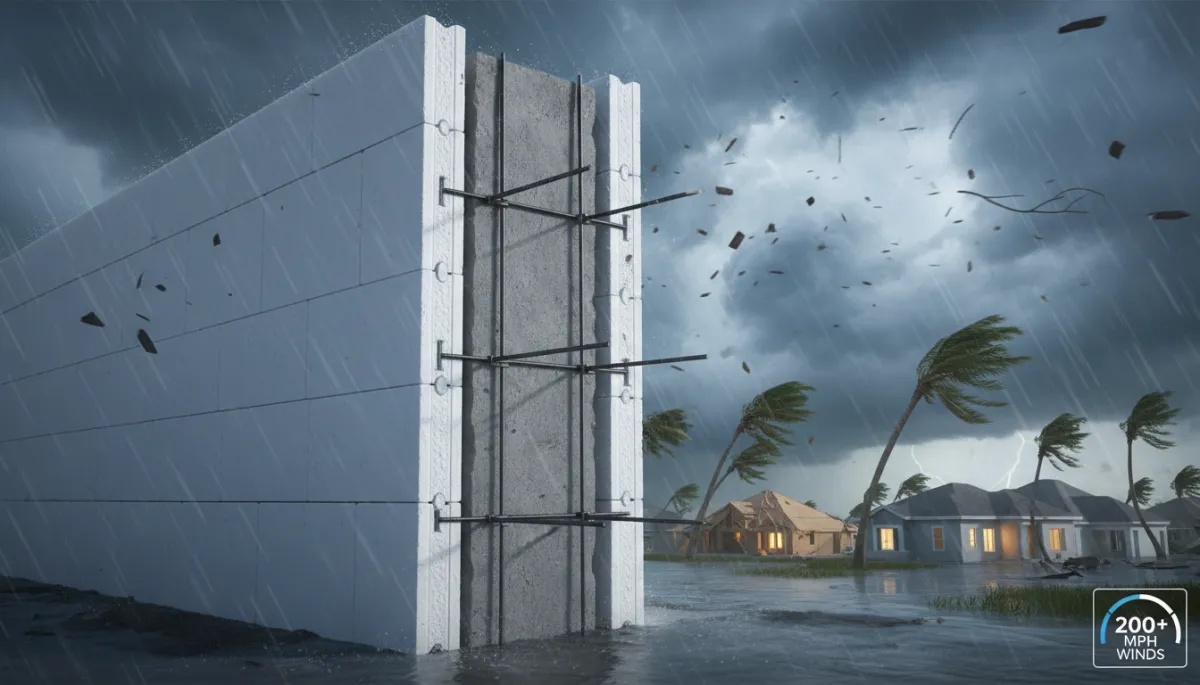
An ICF wall is not a fancy version of wood framing. It is a completely different structural system. Think of it as a solid, steel-reinforced concrete wall, poured in place, wrapped in continuous insulation. The foam forms stay in place permanently, but the real strength comes from the monolithic concrete core — there are no seams, no studs, and no weak points for wind to exploit the way there are in a conventional wood-frame wall.
Monolithic concrete core: Concrete is poured continuously around a rebar cage, creating a single, unified wall section instead of many individual pieces nailed together.
Reinforcing steel: Horizontal and vertical rebar are engineered based on local design wind speeds and exposure, tying the wall into the foundation and roof system for a continuous load path.
Continuous insulation: Foam on both sides of the concrete adds energy efficiency and sound control without compromising structural strength.
Properly engineered ICF walls are rated to resist 200+ mph winds. That is beyond the design wind speeds in most of Florida, even under the coming 9th Edition Florida Building Code, which will adopt the stricter ASCE 7‑22 wind load standard and increase many design wind speeds by 5–10 mph in coastal and inland zones.
📌 Key Takeaway: In a high wind event, wood walls rely on thousands of nails and staples. ICF walls rely on a single, steel-reinforced concrete mass tied from foundation to roof.
Real-World Proof: ICF Homes in Hurricane Michael and Other Major Storms
Engineering data is important, but Florida homeowners also want to know — how do ICF homes actually perform when a Category 4 or 5 hurricane comes ashore? Hurricane Michael in 2018 provided one of the clearest answers we have seen in recent history.
In Mexico Beach and surrounding areas, entire neighborhoods of wood-frame homes were leveled. In aerial photos taken after landfall, you can see block after block of debris — and here and there, a handful of ICF homes still standing. In many cases, those ICF structures suffered damage to roofs, porches, and finishes, but the concrete shell remained intact and plumb while neighboring homes were reduced to slabs and pilings. Industry reports have documented similar performance in other storms, where ICF homes remained structurally sound while adjacent conventional homes were destroyed.
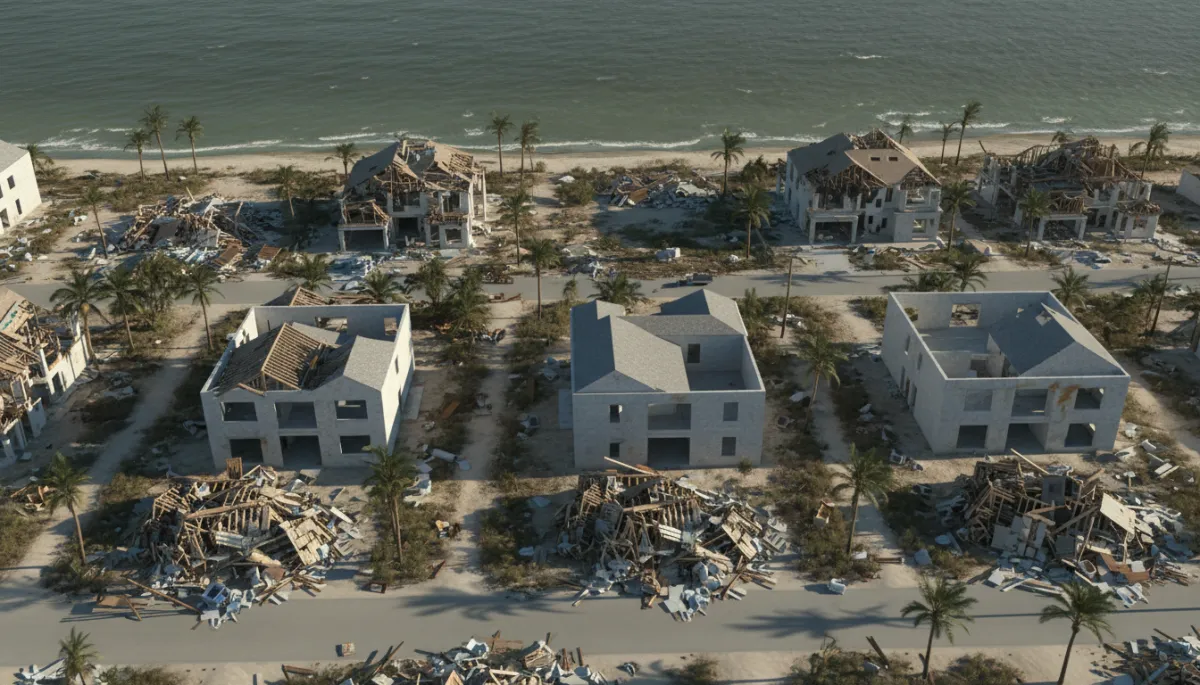
After Hurricane Michael, ICF homes in Mexico Beach remained standing while nearby wood-frame houses were wiped out.
As builders, we pay attention to these case studies because they are real-world stress tests. They show that when wind speeds exceed forecasts, when debris is airborne, and when pressure loads fluctuate rapidly, ICF homes provide a level of storm resistance that conventional framing simply does not match. For families who plan to stay in their homes during a storm — or who want something to come back to afterward — that difference is critical.
Florida Building Codes Are Catching Up — ICF Is Already Ahead
After hurricanes like Michael and Ian, Florida has steadily tightened its building codes. The current 8th Edition Florida Building Code already sets high standards for wind resistance. The upcoming 9th Edition, effective December 31, 2026, goes even further by adopting ASCE 7‑22 wind maps and raising design wind pressures for many areas.
Recent legislation also requires that the entire building envelope — walls, roofs, doors, windows, skylights — withstand 160+ mph winds for certain occupancies, including many coastal residences within five miles of tidal waters and homes in the High‑Velocity Hurricane Zone. At the same time, Florida’s emergency operations centers must be designed to remain functional under similar or higher wind speeds. Across the state, ICF has become a go‑to solution for these critical facilities because it can reliably meet and exceed those thresholds.
When we design an ICF home at LK Homes, we are not aiming for the bare minimum. A wall system rated for 200+ mph winds inherently exceeds the 160 mph envelope requirement that is now being written into law for many structures. That margin matters when storms intensify or track shifts unexpectedly close to shore. It also positions homeowners well for future code changes, instead of constantly playing catch-up with each new edition of the Florida Building Code.
💡 Pro Tip: Ask your builder not only if your home will meet today’s code, but how it will perform against the higher design wind speeds in the 9th Edition Florida Building Code.
A Builder’s Perspective: Why “Minimum Code” Is Not Enough in Florida
Speaking as a builder who has walked job sites after major storms, I can tell you that “built to code” does not always look the way homeowners expect when the wind dies down. Code is a minimum standard — it is the floor, not the ceiling. Meeting code means a structure is legal to build, not that it will be comfortable to live in after a Category 4 or 5 storm, or that it will be quickly repairable if power and materials are scarce for weeks.
I have seen wood-frame homes that technically complied with code lose entire wall sections, roofs peel off at the trusses, and garages collapse inward when doors failed. In contrast, well‑designed concrete and ICF structures on the same streets often had damage limited to roofing materials, windows, and exterior finishes — serious issues, but repairable, with the core of the home still intact and safe to enter. Those experiences are a major reason LK Homes has embraced ICF as a primary structural system for clients who refuse to compromise on safety.
When we sit down with a family, we are not just talking about square footage and finishes. We are talking about where their children will sleep when the forecast cone shifts, where the safest interior room will be if the eyewall passes overhead, and how quickly they want to be back in their home if the surrounding neighborhood is damaged. In that conversation, “minimum code” is not an acceptable target. We design for resilience — and ICF is one of the most reliable tools we have to achieve it.
Beyond Walls: What Makes a True Hurricane Resistant Home
ICF walls are a major step toward a hurricane resistant home, but they are not the whole picture. When you evaluate any new build — whether you work with LK Homes or another contractor — look at the entire system, from foundation to roof to openings. A strong wall system can only perform at its best when everything connected to it is designed with the same philosophy of resilience.
Roof structure and decking: A simplified, well‑braced roof shape with a fully sealed deck, proper sheathing thickness, and hurricane straps or clips tying trusses to ICF walls is essential. The 9th Edition FBC will require sealed roof decks and enhanced connections in many cases — we already design to those standards today.
Impact-rated windows and doors: Laminated, impact-resistant glass, reinforced frames, and properly anchored door assemblies prevent catastrophic breaches that can pressurize the home and lead to roof loss. In many Florida coastal zones, these are now a baseline requirement — we treat them as non‑negotiable in hurricane-prone areas.
Garage doors and openings: Overhead doors are common failure points. Look for high wind-rated, impact-tested units with robust tracks and bracing, anchored into the ICF or concrete structure, not just into furring strips or trim boards.
Foundation and elevation: In surge-prone or flood-prone areas, elevation, proper foundation design, and flood vents or breakaway elements can make the difference between a repairable home and a total loss, even when the walls themselves survive.
Roofing material selection: High-quality underlayments, corrosion-resistant fasteners, and properly installed shingles, metal panels, or tile systems are now central to Florida’s roofing code. Combined with ICF walls, they create a shell that is far more resistant to uplift and water intrusion than older assemblies.
📌 Key Takeaway: A hurricane resistant home is a system — walls, roof, openings, and foundation must all work together. ICF is the backbone, not the entire body.
Fire, Insurance, and Life After the Storm: Hidden Advantages of ICF
Wind is only part of the risk picture in a major hurricane. Downed power lines, gas leaks, and damaged infrastructure often lead to post‑storm fires that spread through neighborhoods when fire response is delayed. ICF walls offer an added layer of protection here as well, with a typical 4‑hour fire rating. That means the concrete core and foam assembly can resist fire exposure for significantly longer than a conventional wood-frame wall, slowing the spread of flames and giving occupants more time to evacuate or shelter safely.
Insurers in Florida are paying attention to this performance. Many carriers now offer premium discounts for homes built with ICF or other hardened systems, especially when combined with documented wind mitigation features. While every policy is different, we regularly see clients benefit from lower ongoing insurance costs because their homes are engineered for resilience, not just code compliance. Over the life of the home, those savings can offset a significant portion of the initial investment in ICF and other storm-hardening measures.
Building a Home You Can Shelter in Place In — Not Just Evacuate From
For many Florida families, evacuation is not always possible. Work obligations, medical needs, limited shelter space, or last‑minute track changes can mean staying put. When we talk about ICF homes storm resistance or wind resistant home construction Florida, what we are really talking about is the ability to shelter in place with confidence — knowing the structure around you is designed to handle more than the forecast calls for.
An ICF home, paired with impact-rated openings, a hardened roof, and smart mechanical design, creates a quiet, stable interior environment even when winds roar outside. The thick concrete and insulation significantly reduce noise and pressure fluctuations. Temperatures remain more stable if power is lost, buying valuable time for families, especially those with young children or older adults. For some homeowners, integrating solar and battery backup or standby generators adds another layer of resilience, allowing key systems to keep running until utilities are restored.
“When we hand over the keys to an ICF home, we are not just delivering a house. We are handing a family a shelter they can trust when the forecast cone turns our way.”
— LK Homes Builder Perspective
Why LK Homes Builds with ICF for Safety-Focused Florida Homeowners
LK Homes — “Building Dreams Within Reach” — is a new construction specialist serving Florida, with a focus on durable, storm-ready homes that do not force families to choose between safety and affordability. We build with ICF because, in our professional judgment, it is one of the most effective ways to deliver long‑term value in a hurricane-prone state: structural strength, energy efficiency, noise reduction, and lower maintenance, all in one system.
For homeowners searching for a hurricane resistant home builder Florida, our role is to be a guide as much as a contractor. We explain how different wall systems perform, how upcoming code changes may affect your design, and where investing a little more today can save you significantly in repairs, insurance, and stress over the life of the home. Whether you are building a custom residence in Central Florida or a coastal retreat closer to tidal waters, our ICF designs are tailored to your site, your risk profile, and your budget — without compromising the safety fundamentals.
💡 Pro Tip: When you interview builders, ask how many ICF projects they have completed, how they tie the ICF walls into the roof and foundation, and what wind speeds they design to — not just what the local code requires.
FAQ: ICF Homes and Hurricanes in Florida
1. Are ICF homes truly hurricane proof in Florida?
No home can be guaranteed hurricane proof under every possible scenario. However, ICF homes are engineered to withstand 200+ mph winds, far exceeding the design wind speeds in most Florida locations. When paired with impact-rated windows and doors, a hardened roof system, and proper elevation in flood-prone areas, an ICF home offers one of the highest levels of storm resistance available in residential construction today.
2. How did ICF homes perform in Hurricane Michael and other major storms?
During Hurricane Michael in 2018, ICF homes in and around Mexico Beach remained standing while many neighboring wood-frame homes were leveled. Industry case studies show similar results in other hurricanes — ICF structures typically suffer damage to roofs, windows, and finishes, but the main concrete shell often remains intact and repairable. This real-world performance is one of the strongest arguments for choosing ICF in hurricane zones.
3. Does building with ICF help with insurance costs in Florida?
Many Florida insurance carriers recognize the reduced risk associated with ICF construction and offer premium discounts for homes that incorporate ICF walls, impact-rated openings, and other documented wind mitigation features. Exact savings vary by carrier and location, but over time, lower premiums can offset a portion of the higher upfront investment in ICF and related upgrades. A detailed wind mitigation inspection report is often required to unlock these credits.
4. How does ICF compare in cost to wood framing, and is it worth it?
ICF typically costs more upfront than basic wood framing, but the gap has narrowed as lumber prices and code requirements have increased. When you factor in energy savings, lower maintenance, potential insurance discounts, and the reduced risk of major storm damage, many homeowners find that ICF offers better long‑term value. At LK Homes, we work with clients to compare scenarios and design an ICF home that fits both their budget and their resilience goals.
5. If I build with ICF, what else should I include for a truly hurricane resistant home?
Start with ICF walls, then add a well‑engineered roof system with a sealed deck and hurricane straps, impact-rated windows and doors, wind-rated garage doors, and appropriate foundation elevation and drainage for your flood zone. Consider backup power options and mechanical layouts that support comfort if utilities fail. A hurricane resistant home is the sum of these parts — ICF provides the structural backbone, but the full design determines how confidently you can shelter in place.
Ready to Build a Safer Home in Florida? Schedule a Free Consultation
If you are planning to build in Florida and want a home that does more than meet minimum code, LK Homes is here to help. As an experienced hurricane resistant home builder specializing in ICF and other resilient systems, we can walk you through design options, cost comparisons, and code requirements so you can make informed decisions for your family’s safety and long‑term investment.
Visit lkhomebuilder.com or go directly to https://lkhomebuilder.com/blog/icf-homes-hurricane-proof-florida to learn more about ICF construction, then contact us to schedule a free consultation. Together, we can design and build a home that is ready for the next storm — not just the last one.
