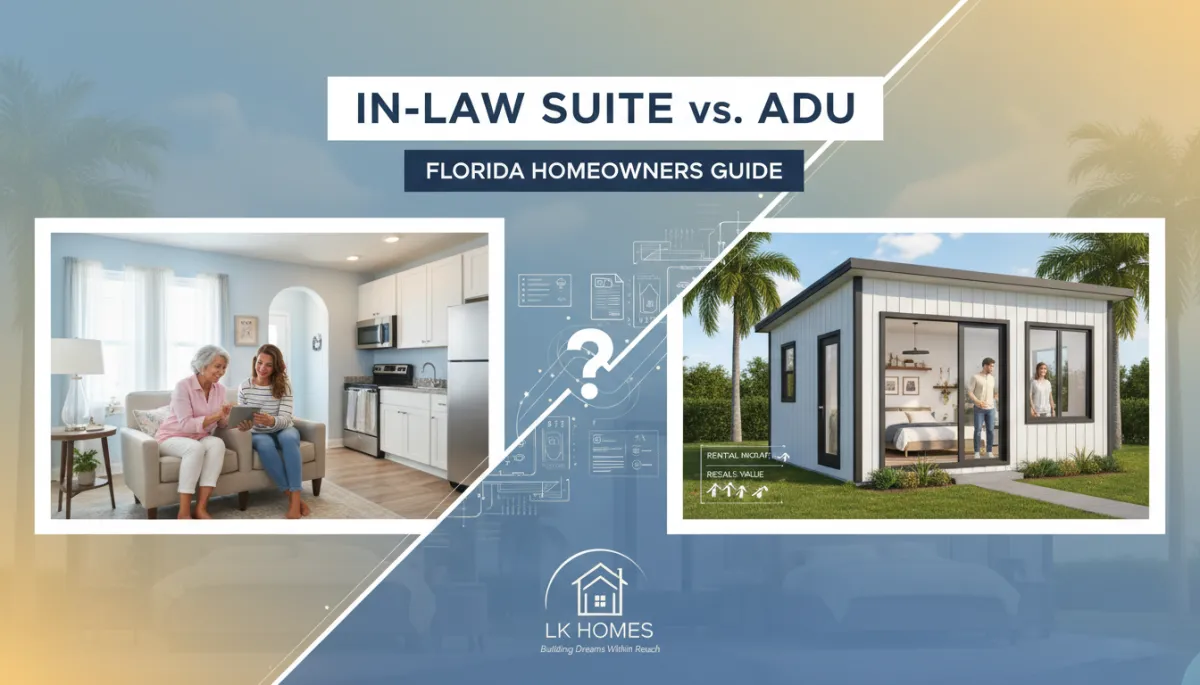
In-Law Suite vs ADU: Florida Home Building Guide
In-law suite vs ADU Florida, multigenerational home builder Florida, ADU vs in-law suite, guest house vs ADU Florida
In-Law Suite vs. ADU in Florida: What’s the Difference and Which Should You Build?
If you’re a Florida homeowner planning for multigenerational living, you may be torn between building an in-law suite or a full accessory dwelling unit (ADU). On paper they look similar. In reality, the choice can shape your family’s daily life, financial flexibility, and long-term options for decades. This guide from LK Homes, “Building Dreams Within Reach,” walks you through the real differences so you can make a confident, family-first decision.
Why This Decision Matters More Than It Looks
Across the United States, multigenerational living is the fastest growing housing trend. According to the U.S. Census Bureau and research summarized by organizations like Pew, tens of millions of Americans now live in homes that include grandparents, adult children, and sometimes even grandchildren under one roof. Rising housing costs, an aging population, and a desire for closer family ties are all pushing this change.
Nowhere is this more visible than in Florida. Our state’s older population is growing quickly, and many families are looking for ways to bring aging parents closer while still giving everyone privacy and independence. At the same time, younger adults are staying home longer or returning after college to save for their own place. The result: more Florida homeowners asking, “Should we build an in-law suite or a full ADU?”
📌 Key Takeaway: You’re not just choosing a floor plan. You’re choosing how your family will live together, how your property will perform financially, and what options you’ll have 5, 10, or 20 years from now.
In-Law Suite vs ADU in Florida: The Core Definitions
What Is an In-Law Suite in Florida?
An in-law suite (sometimes called a “mother-in-law suite” or “granny flat”) is typically a semi-independent living space that is part of the main home or attached to it. Think of:
A converted bedroom with its own bathroom and sitting area
A garage conversion tied directly into the house
An addition with a bedroom, bath, and small kitchenette that still functions as part of the main dwelling
Legally, Florida statutes don’t use the term “in-law suite.” Counties often treat these as a remodel or addition to the existing single-family residence. They usually:
Share utilities (electric, water, sewer) with the main home
May or may not have a full kitchen, depending on local rules
Often use the same front door or hallway, even if there’s a separate side entrance
What Is a Full ADU in Florida?
An Accessory Dwelling Unit (ADU) is defined in Florida law as a separate, independent residential unit on the same lot as a primary home. Under Florida Statutes §163.31771 and related guidance, a full ADU must have:
A complete kitchen (cooking appliance, sink, refrigeration, cabinetry)
A dedicated bathroom
A defined sleeping area (bedroom or studio-style sleeping space)
A separate entrance from the main house
ADUs can be attached, above a garage, or fully detached. What matters is that they are a self-contained home that can legally function on its own. With recent reforms like Florida’s Live Local Act and related ADU provisions (often referenced under HB 1339), full ADUs are now easier and faster to permit than ever before, with streamlined approvals and limits on extra design requirements or impact fees.
💡 Pro Tip: If it has a full kitchen, bathroom, sleeping area, and its own entrance, your county will almost always treat it as an ADU, not just a “suite,” even if you call it one.
How Florida Counties and Lenders Treat In-Law Suites vs. ADUs
Permitting and Utilities
In-law suite Florida permitting: Because in-law suites are typically inside the existing building envelope or attached to it, they’re often permitted as:
An interior remodel (converting space you already have), or
A home addition that remains part of the single-family dwelling
They usually share utilities with the main house. You’ll still need building permits for structural work, electrical, plumbing, and HVAC, but you may not need a separate meter or separate impact fees in many jurisdictions because it isn’t classified as a standalone unit.
ADU permitting in Florida: A full ADU goes through a more defined process:
Full site plan and building permit review, including zoning checks for setbacks, height, and size limits
Compliance with the Florida Building Code, including hurricane and flood requirements where applicable
Inspection and a Certificate of Occupancy for the new dwelling
Recent statewide reforms, including provisions under HB 1339, have made this process faster and more predictable by requiring ministerial (administrative) approvals when you meet objective standards and by capping impact fees. In other words, if your design follows the rules, the county has to approve it without lengthy hearings or subjective design demands.
Rental Rules and Resale Value
One of the biggest differences between an in-law suite and a full ADU in Florida is how the space can be used over time:
Full ADUs are generally allowed to be rented independently (subject to local rules and any HOA restrictions), because they legally qualify as a separate dwelling. Some cities may restrict short-term rentals under 30 days, but long-term leases are typically allowed.
In-law suites are usually considered part of your single-family home. Renting them out separately often requires additional permitting or rezoning, and in many areas it’s not allowed at all without upgrading the space to ADU standards.
From a value standpoint, national and Florida market data increasingly shows that homes with a legal, rentable ADU command significantly higher resale prices. Properties with full ADUs can see 23–28% higher resale value compared to similar homes with only in-law suites, which do add value but in a more subjective and less predictable way because buyers can’t always monetize them the same way.
How Lenders See the Difference
Lenders and appraisers tend to be more conservative with in-law suites. Because they’re part of the main home, value is often captured as “extra finished square footage” or a “bonus room,” not a separate income-producing unit. A full ADU, however, can sometimes be valued with comparable sales of other properties that have ADUs, and in some cases, appraisers may consider potential rental income when supported by local market data and lending guidelines.
A properly permitted ADU can function as family housing today and flexible income or resale value tomorrow.
The Cost Question: Is an ADU Really That Much More?
Many families come to LK Homes assuming that a full ADU will cost dramatically more than an in-law suite. In reality, the cost difference between a well-built in-law suite and a full ADU is often smaller than they expect, especially when the in-law suite includes:
A new bathroom with plumbing and ventilation
Added HVAC capacity or a mini-split system
A kitchenette or wet bar with cabinetry and electrical upgrades
Once you’re already investing in plumbing, electrical, finishes, and sometimes structural changes, the incremental cost to add a full kitchen, a slightly larger footprint, or a dedicated entrance may be modest compared to the long-term flexibility and potential income a full ADU can provide. This is where thoughtful design and honest budgeting with an experienced Florida builder really matter.
Real Family Story: Upgrading from In-Law Suite to Full ADU with LK Homes
When the Ramirez family from Central Florida first met with LK Homes, they were certain they wanted a simple in-law suite. Maria’s mother was moving from out of state, and their main concern was giving her a private bedroom and bathroom connected to the house so she wouldn’t feel isolated. They pictured a comfortable sitting area, maybe a small coffee bar, and easy access to the kitchen for shared meals.
During our design consultation, we walked through their goals in detail. We asked:
How long do you expect your mom to live with you?
What happens if she eventually needs more intensive care elsewhere?
Could one of your adult children need a private space in the future?
Would you ever consider renting the space for extra income?
As we modeled different options and budgets, the Ramirezes realized that by slightly extending the footprint, adding a full kitchen, and giving the space its own exterior entrance, they could transform their original in-law suite concept into a fully legal ADU. The cost difference was meaningful but not overwhelming—especially when they saw how much more flexible the ADU would be over 10–20 years of family life.
Today, Maria’s mom enjoys her own quiet, sun-filled apartment just steps from the main house. She can cook her favorite meals, host friends, and still walk over for dinner with the family. Down the road, the Ramirezes plan to use the ADU for a college-aged daughter and, eventually, as a long-term rental to supplement retirement income. Their comment to us after move-in was simple: “We almost built an in-law suite that would have boxed us in. We’re so glad we slowed down and built for the future.”
A Builder’s Honest Opinion: The Hidden Cost of Stopping at an In-Law Suite
Speaking as a Florida home builder who specializes in multigenerational design, we see a pattern over and over: families build an in-law suite when they could have built a full ADU for a modest additional investment. A few years later, they realize they can’t rent the space, can’t easily convert it, and can’t capture the same resale value as a property with a legal second unit. At that point, “upgrading” often means tearing out finishes, re-permitting, and spending more than if we had done it right the first time.
From our perspective, stopping at an in-law suite when your property and budget can support a full ADU is one of the most common and expensive mistakes Florida homeowners make. Not because in-law suites are bad—they’re wonderful in the right context—but because they often lock a family into a single-purpose space in a world where flexibility is priceless.
Florida’s 2024 ADU Reforms: Why ADUs Are Easier Than Ever
Florida’s leaders recognize that we need more housing options for seniors, working families, and young adults. Recent legislation, including the Live Local Act and related 2024 ADU reforms, has made it easier and more affordable to permit full ADUs statewide. Key changes include:
No owner-occupancy requirement for ADUs under state law, giving families more flexibility in how they use or rent the space
Ministerial permitting, meaning that if your ADU meets clear standards, the local government must approve it administratively without subjective hearings
Caps on impact fees so ADUs are not charged more than single-family homes for the same services
Combined with local zoning updates and a strong statewide push toward more flexible housing, these reforms mean that, in many Florida communities, the permitting path for a full ADU is now clearer and faster than it was just a few years ago. LK Homes stays on top of these evolving rules so we can design ADUs that meet code, pass inspection, and support your long-term plans.
Five Questions to Answer Before You Choose In-Law Suite or ADU
Before you commit to one path, sit down as a family and honestly answer these five questions. At LK Homes, we use them in nearly every multigenerational consultation.
1. Who will live there?
Is this space primarily for an aging parent who needs support but values independence? An adult child launching their career? Visiting family a few times a year? The more independence and privacy your loved one needs, the more an ADU starts to make sense. If it’s truly just extra bedroom space for occasional guests, an in-law suite may be enough.
2. How long will they live there?
If you’re planning for a short-term situation—say, a parent recovering from surgery for six months—an in-law suite addition or conversion might be the simplest answer. But if you expect a parent or adult child to live there for years or decades, designing a fully functional ADU can dramatically improve quality of life for everyone by reducing friction over shared kitchens, noise, and schedules.
3. Will it ever be rented?
Even if renting isn’t part of your immediate plan, ask yourself honestly: “Would we want the option?” A full ADU is designed to be a legal, rentable unit (subject to local and HOA rules). An in-law suite usually is not. If the idea of future rental income—whether to help with college tuition, offset retirement costs, or buffer against inflation—sounds appealing, that’s a strong argument for an ADU.
4. Does it need a full kitchen?
A full kitchen is the line between a “suite” and a “home.” If your loved one will be preparing their own meals regularly, has dietary needs, or simply values culinary independence, a complete kitchen in a full ADU can make daily life smoother and more dignified. If the plan is to share every meal in the main house, a kitchenette may be sufficient—but recognize that you’re also limiting future uses of the space.
5. What happens to the space in 10 years?
This is the question that changes everything. In 10 years, your parents’ health, your children’s ages, and your own career and financial picture may look completely different. A thoughtfully designed ADU can become:
A home for an adult child returning after college
A rental unit generating steady monthly income
A private office or studio that can still convert back to housing later
An in-law suite, by contrast, is usually locked into one primary use: extra space for family or guests. It can be wonderful for that purpose, but it rarely unlocks the same level of flexibility or financial resilience.
📌 Key Takeaway: The choice between an in-law suite and an ADU is really a choice about flexibility. An in-law suite serves one purpose. A full ADU can serve almost every purpose—family housing, rental income, resale value, and future options you can’t yet see.
How LK Homes Helps Florida Families Navigate This Decision
At LK Homes, our mission is “Building Dreams Within Reach.” That means we don’t walk into a meeting pushing ADUs or in-law suites. We walk in asking questions about your family, budget, and long-term plans. We look at your lot, your local zoning, your HOA rules, and your financial comfort zone. Then we model different scenarios side by side so you can see:
What an in-law suite would cost and how it would function day to day
What a full ADU would cost, how it would change your options, and how it could impact resale and potential rental income
Because we focus on new construction and major additions across Florida, we understand the subtle differences between counties, the latest ADU reforms, and what local inspectors are really looking for. Our role is part builder, part guide: we translate complex regulations into clear choices that support both your family dynamics and your financial goals.
FAQ: In-Law Suite vs. ADU in Florida
1. Is an in-law suite the same as an ADU in Florida?
No. An in-law suite is usually an attached or interior space that remains part of your single-family home and often shares utilities and access. An ADU is a legally defined, independent dwelling with its own kitchen, bathroom, sleeping area, and entrance. Counties, appraisers, and lenders treat them differently, especially when it comes to rental use and valuation.
2. Can I rent out an in-law suite in Florida?
In many areas, you cannot legally rent an in-law suite as a separate unit without additional permits or rezoning, because it’s not recognized as its own dwelling. Some homeowners do this informally, but it can create issues with code enforcement, insurance, and taxes. A full ADU, by contrast, is designed and permitted specifically to function as an independent home that can often be rented long-term, subject to local and HOA rules.
3. Does a full ADU really increase resale value that much?
Market data and builder experience suggest that homes with a properly permitted ADU can sell for 23–28% more than similar homes with only an in-law suite or no secondary unit at all. Buyers are willing to pay a premium for flexible, income-producing space—especially in states like Florida where multigenerational living and rental demand are both rising. In-law suites add value, but the impact is typically smaller and more subjective.
4. Is building a full ADU much more expensive than an in-law suite?
It depends on the design, but for many Florida families the gap is smaller than expected. Once you’re adding a bathroom, upgrading electrical and HVAC, and finishing high-quality living space, you’ve already covered many of the big-ticket items. The additional cost to create a fully independent ADU—especially when planned from the start—can be modest compared to the long-term flexibility, rental potential, and resale value it unlocks. A detailed quote from a builder like LK Homes will give you clear numbers for your property.
5. How do I decide what’s right for my family and property?
Start with the five questions in this article: who will live there, for how long, whether you might rent it, if a full kitchen is needed, and what you want the space to be in 10 years. Then, talk with a Florida builder who understands both multigenerational living and local ADU rules. At LK Homes, we combine family-focused design with up-to-date knowledge of Florida’s ADU and permitting landscape to help you choose a solution that truly fits your life—not just today, but for the seasons ahead.
Ready to Explore Your In-Law Suite or ADU Options?
If you’re weighing an in-law suite vs ADU in Florida, you don’t have to figure it out alone. LK Homes is a multigenerational home builder for Florida families, specializing in new construction, additions, and carefully planned ADUs that honor both your relationships and your resources. We’ll walk your property, listen to your story, and design a solution that keeps your loved ones close while keeping your options open.
Schedule a free, no-pressure consultation today to compare an in-law suite and a full ADU side by side for your specific home, budget, and long-term goals. Together, we’ll build a space that feels right for your family—and works hard for your future.
